About Glaucidium hardyi Vielliard, 1989
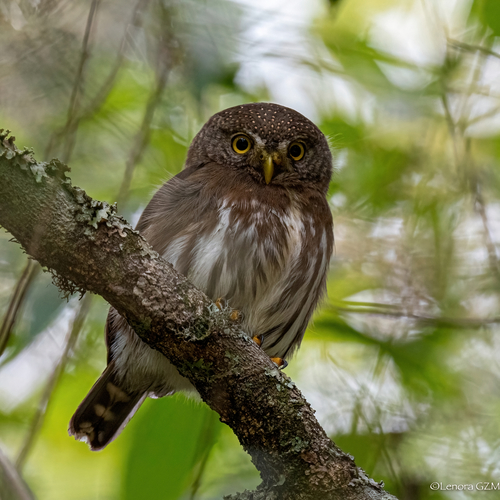
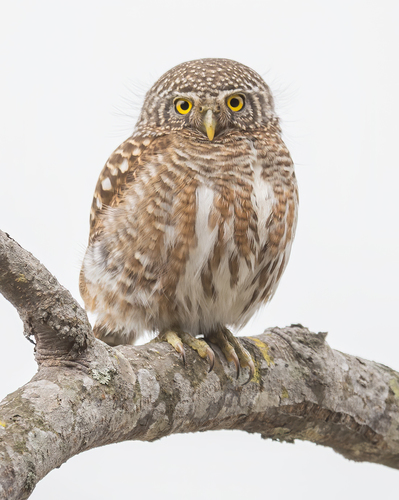
Physical description: The Amazonian pygmy owl is a very small owl, as reflected by its genus name Glaucidium, which means "little owl". Adult individuals have a large, round head marked with black spots that falsely resemble eyes. Their crown is gray-brown and covered with very small white spots. Both the rectrices (tail feathers) and remiges (wing flight feathers) are dark brown, marked with three irregular bars of large white spots. Their underparts are white with broad brown or rufous brown streaks. This species measures 14–15 cm in total length, and adults typically weigh approximately 60 g. No sexual dimorphism has been observed in adults, meaning males and females are identical in appearance. Juveniles look similar to adults, but have unspotted crowns and less distinct streaking on their underparts. The Amazonian pygmy owl has bright golden yellow irises, a greenish yellow bill, and a pale yellow cere. Its talons are arranged in a zygodactyl pattern. Distribution: The Amazonian pygmy owl is found in central and southwestern parts of the Amazonia region. Its presence has been confirmed in northern Bolivia, Peru (both in the Amazon and north of the Amazon), and ranges eastward to eastern Venezuela, Guyana, Suriname, and French Guiana. Habitat: This owl inhabits the canopy and subcanopy of tall, humid, tropical evergreen forests. It has been observed at elevations ranging from lowlands up to above 1100 meters. Ecology: The Amazonian pygmy owl is one of the most common predators in the northern Amazon basin. As a defense mechanism, its prey often engages in mobbing behavior targeting this owl.