About Glaucidium gnoma Wagler, 1832
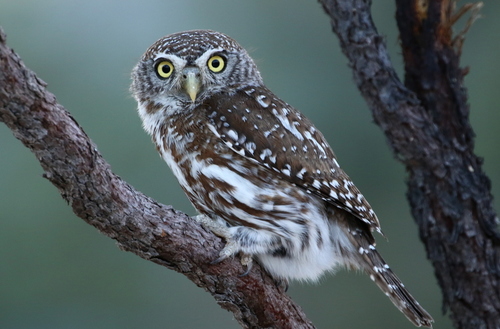
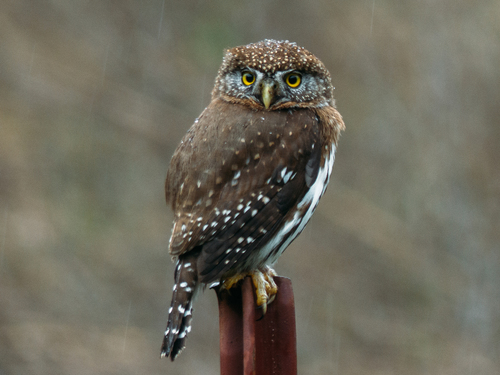
Adult mountain pygmy owls (Glaucidium gnoma) measure approximately 15–17 cm (5.9–6.7 in) in total length. Males weigh 48 to 54 g (1.7–1.9 oz); this species shows reverse sexual dimorphism, so adult females are heavier, ranging from 60 to 73 g (2.1–2.6 oz). Male wing length falls between 86–89 mm (3.4–3.5 in), while female wing length ranges from 87–98 mm (3.4–3.8 in). Tail length for both sexes measures 61–66 mm (2.4–2.6 in). Adult plumage follows the typical pattern of most pygmy owls. The chest and throat are white, and the face is a deeper brown. The facial disk is pale brownish-red (rufous) with scattered cream flecks, and the owls have thin, white eyebrows. The head, neck, wings, and tail have a pale rufous base color patterned with cream spots. The outer tail has 5 to 6 alternating white and rufous bands, while the underside of the tail has 3 to 4 alternating bars. The chest and body underside are white with broken vertical red-brown streaks. The iris, feet, and bill are all yellow. Newly hatched nestling chicks are covered in whitish natal down feathers. A second layer of down begins to grow within a few weeks of hatching. Fledgling juvenile plumage looks similar to adult plumage, but the crown (top of the head) is grey, the forehead has very little spotting, and the white eyebrows are thicker and more prominent than those of adults. Members of the northern pygmy owl complex share similar traits, but each has distinct identifying characteristics. Compared to the larger northern pygmy owl, which has rounded wingtips and a longer tail, the mountain pygmy owl is small with a short tail and slightly pointed wingtips. The Guatemalan pygmy owl can be told apart by its vibrant red-brown plumage and white central tail bars bordered by dark trim. The Baja pygmy owl is similar in small size to the mountain pygmy owl, but it shares the northern pygmy owl’s rounded wingtips and has a solid white throat. The mountain pygmy owl lives in mountainous tropical and subtropical oak, pine, and evergreen forests at elevations between 1,500 and 3,500 m. It prefers forests dominated primarily by Ponderosa pines, because the reduced understory in these forests makes hunting easier. This species is distributed from southern Arizona and New Mexico in the United States south to Oaxaca in southern Mexico. Very little direct observation exists of the mountain pygmy owl’s social behavior and reproduction. The information below is generalized from data on the Eurasian pygmy owl, which is applied to the northern pygmy complex. Sexual maturity can begin at 5 months of age, with breeding occurring once individuals reach 1 year old. Pygmy owls form monogamous pairs that usually last for one breeding season, though pairs may return to the same nesting site for up to four years. During courtship, the male produces a series of consistent hoots while jumping between branches within his claimed territory. At first, both sexes show hesitation and aggression toward one another. Duet singing stops once the male begins nesting behaviors. Nests are built in hollowed tree cavities or abandoned woodpecker holes. After the male finds a potential nesting site, he flies into it and calls to alert the female, so she can inspect the cavity. The female selects the preferred cavity and cleans it, and copulation takes place shortly after. Mountain pygmy owls lay eggs between May 19 and June 14. Clutches contain 2 to 4 white eggs, which are laid at the base of the nest cavity. The female does not start incubation until all eggs have been laid; incubation lasts approximately 28 days. This delayed start means all chicks hatch within a short window of one another. Mountain pygmy owls are thought to have similar feeding behavior to the Eurasian pygmy owl. After the eggs hatch, the male provides most of the food for the female. By around 14 days after hatching, nestlings have reached approximately 60% of their adult body weight. Across observed pygmy owl species, juveniles develop the ability to fly and leave the nest 23 to 30 days after hatching. The parent pair stays near the nest and continues providing protection for an additional 20 to 30 days after juveniles fledge.