About Glaucidium brodiei (Burton, 1836)
Scientific name: Glaucidium brodiei (Burton, 1836)
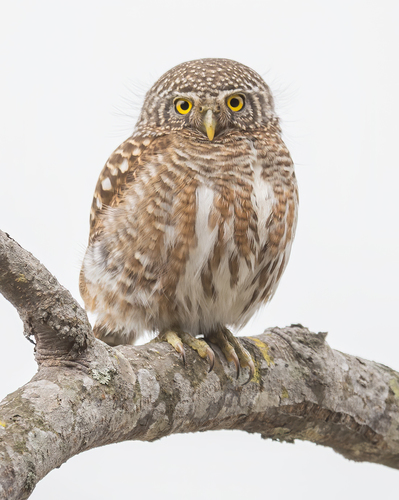
Commonly called the collared owlet, it is the smallest owl species native to Asia. It measures between 15 and 17 centimeters in length. Females are typically larger than males: females weigh approximately 63 grams, while males weigh around 52 grams. Depending on its age morph, the owl has a grey-brown base color, with barring on its back and flanks, while its head has more spotting than barring. It has prominent white eyebrows, bright lemon-yellow eyes, and a white throat patch. The chin, the center of the breast, and the belly are mostly white. Its pale collar and two black spots on each side of the nape work as false eye spots, creating the illusion that the owl is staring at you from behind; this feature is called the "occipital face". It has a greyish-brown, pale-spotted pectoral band across its upper breast and lacks ear tufts. When in flight, its longer tail (longer than most other pygmy owls) is visible, and it has rapid wingbeats.
The collared owlet is a resident bird throughout its range. It has a very large distribution that spans from the Himalayas of northern Pakistan all the way to eastern China and Taiwan, and extends south through Malaysia. It can be found in Bhutan, Brunei Darussalam, Cambodia, China, India, Laos, Malaysia, Myanmar, Nepal, Taiwan, Thailand and Vietnam.
Its preferred habitats include evergreen forests, forest edges, mixed deciduous-evergreen forests with oak, rhododendron and fir, and open woodlands with scrub. It primarily occupies submontane and montane habitats at altitudes between 1350 and 2750 meters, but has also been observed near cultivated land at altitudes as low as 700 meters. Like other species in the genus Taenioptynx, the collared owlet is a secondary cavity-nester: it does not build its own nest, instead nesting in natural tree hollows or cavities created by woodpeckers and barbets.
The collared owlet is most active during daylight. As a diurnal species, it perches, hunts, and calls through most of the day, and is sometimes active at night as well. When it is roosting, other small birds often mob it. There are few studies that have precisely identified the collared owlet's exact diet, but it is presumed similar to the diet of its closest relative, the jungle owlet. Jungle owlets prey on small mammals including house mice, little Indian field mice, brown spiny mice, and white-toothed pygmy shrews, as well as reptiles like skinks, birds, amphibians, and many invertebrates. As such, the collared owlet's diet consists mainly of small birds, insects, lizards, invertebrates, and small mammals. Despite its small size, this raptor is extremely fierce, and has been recorded capturing prey as large as itself. After catching prey, it carries the prey to a perch with its talons, then tears it apart with upward pulls of its bill.