About Glareola nuchalis G.R.Gray, 1849
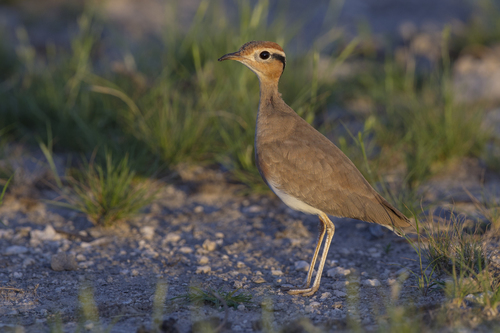
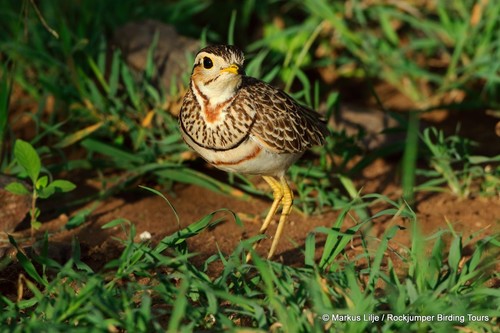
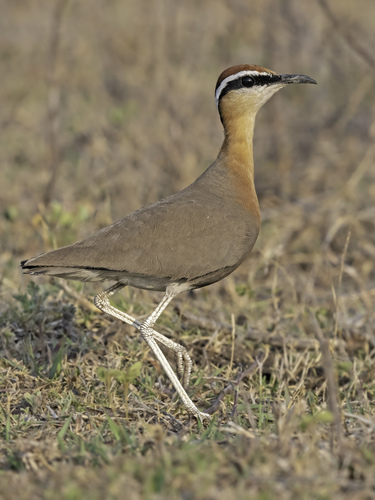
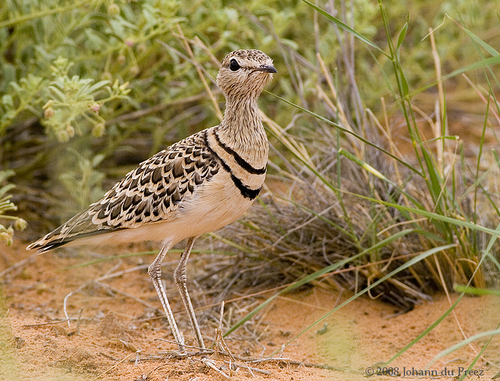
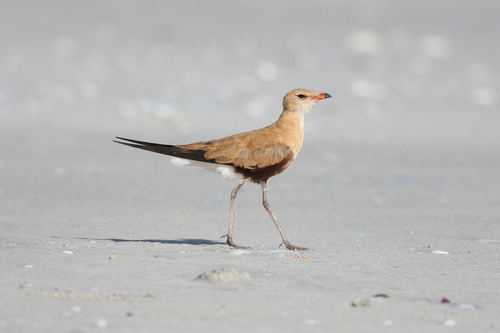
The rock pratincole (Glareola nuchalis G.R.Gray, 1849) is a wading bird native to Africa. Mature adults have dark gray or brown plumage, with a white collar-like line that starts beneath the eye and extends to the back of the neck. They have long dark wings with a clear white patch on the underwing, a forked tail, and usually a white belly. Their bill is black with a red base, while the legs and eyes are coral red. Both sexes produce a faint whistling contact call and musical purring, and become very noisy when acting aggressively. Standard measurements for this species are: length 16.5–19.5 cm, wing length 14.3–16.0 cm, bill length 10–12 mm, tail length 5–6 cm, and body mass 43–52 grams. There are two recognized subspecies of rock pratincole. G. n. liberiae (Schlegel, 1881), also called rufous-collared pratincole, ranges from Sierra Leone to western Cameroon. G. n. nuchalis (Gray, 1849), also called white-collared pratincole, ranges from Chad to Ethiopia, south to southern Angola, and from northeast Namibia to western Zambia and Mozambique. This species lives along rocky river and lake embankments, and its seasonal movements are determined by local water levels. It is an intra-African migrant, found peripherally along the coast of South Africa in equatorial regions. The birds migrate away when their habitat areas flood, and return when rocks become exposed during drought. They live in flocks of around 26 pairs on and around these rocks. They feed on insects during the morning and evening, and wade in cool water during the hottest part of the day. They will also feed during the day when conditions are overcast. They are regularly seen perched on hippopotamuses to scavenge for insects. Their diet is made up mostly of flies, moths, ants, beetles, grasshoppers, and cicadas, and they attack their prey from the air.