About Glabridorsum stokesii (Cameron, 1912)
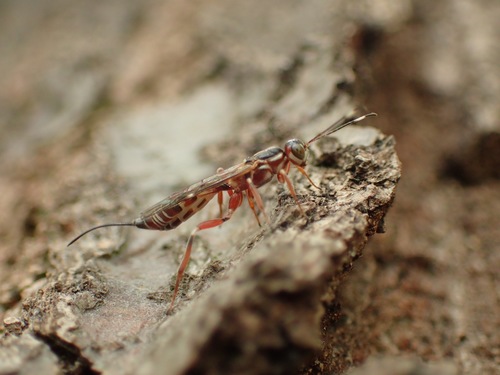
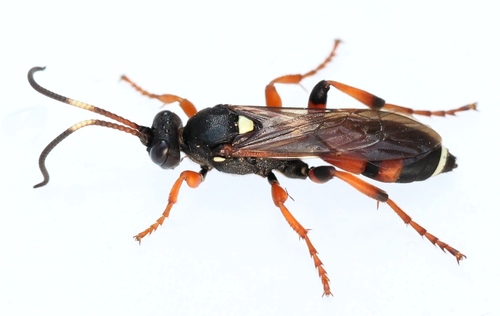
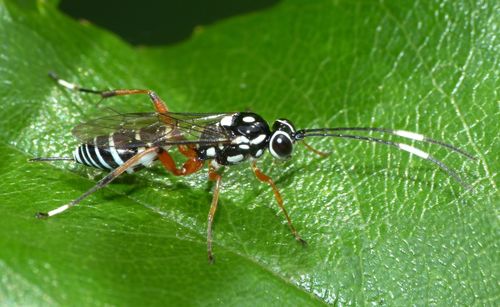
Identification: In New Zealand, Glabridorsum stokesii can be distinguished from the similar species Xanthocryptus novozealandicus by a complete, uninterrupted white band surrounding its eyes; X. novozealandicus does not have a complete white eye band.
Below is Cameron's original species description: The body is black. The abdominal petiole is red, except for its apex. The face, clypeus, basal half of the mandibles, palpi, and the orbits all around (more broadly on the malar space, where the yellow color extends to the base of the mandible), a broad line on the sides of the pronotum (extending inward to shortly beyond the base of the parapsidal furrows), a mark on the apex of the middle lobe that is twice as long as it is wide with a rounded base and transverse apex, the scutellum, the apical slope of the metanotum (tapering gradually from the outer side towards the top), tubercles, a longish triangular line on the lower basal half of the propleurae, a large spot on the base of the mesopleurae (bluntly rounded at the top, gradually widening on the apical side towards near the bottom, which projects into a square shape), the typical mark below the hind wings, a large triangular mark (narrowed at the upper end) on the metapleurae, and the apices of all abdominal segments are whitish-yellow. The eighth to fourteenth antennal joints are white. The wings are hyaline, the stigma and nervures are dark fuscous, with the stigma darker at the front. The areolet is narrowed in front, and is the same width there as the areolet bounded by the recurrent and second transverse cubital nervures; the recurrent is received at the base of the apical third. The pro- and mesothorax are smooth; the furrows are crenulated, with parapsidal furrows weakly crenulated and sternal furrows more strongly crenulated. The area immediately below the tegulae, extending to the yellow mark, is striated, and the striae continue down the upper half of the furrow. The base of the metanotum is weakly and sparsely punctured, while the rest of the metanotum is rather strongly punctured and weakly reticulated; the second transverse keel is weaker than the basal keel. The abdomen is smooth and shining, except for the second segment, which is opaque and aciculated.
Cameron's female holotype measured 7 mm (0.28 in) in length. It was collected in Glen Innes, New South Wales in January, found laying eggs in weevil larvae.
Distribution: This species is native to southeastern Australia. It was introduced to New Zealand between 1969 and 1974 to control moth species that damage fruit crops, and successfully established populations in Auckland and Hawkes Bay. By the 2020s, G. stokesii had become common across both the North Island and South Island of New Zealand, and has been identified in the Australian states of Queensland, New South Wales, Victoria and Tasmania. Between 1932 and 1939, attempted introductions of this species (then referred to as Gambrus stokesii) were carried out in the United States as part of pest control programs, but the species failed to establish there.