About Girella zebra (Richardson, 1846)
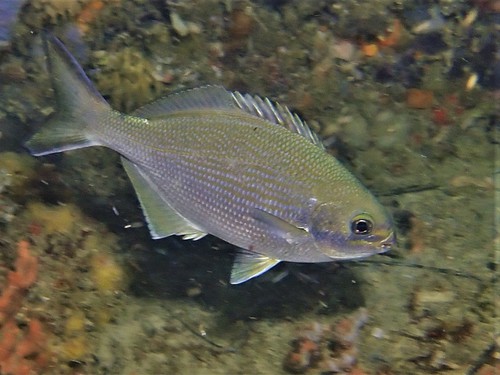
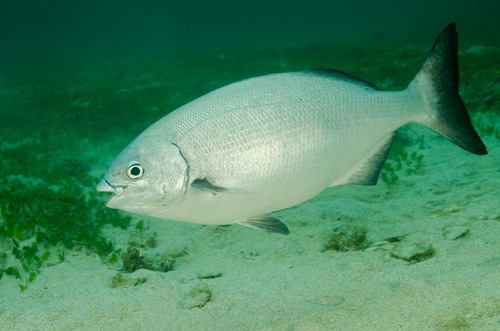
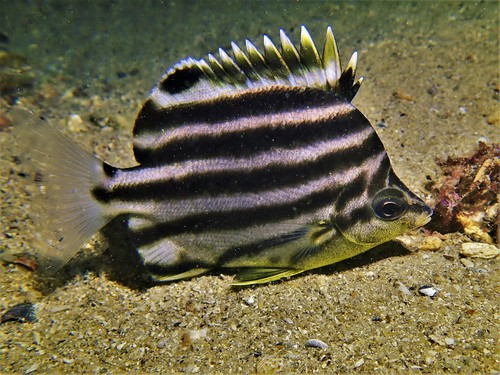
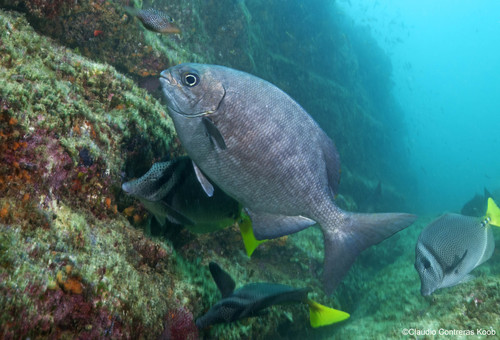
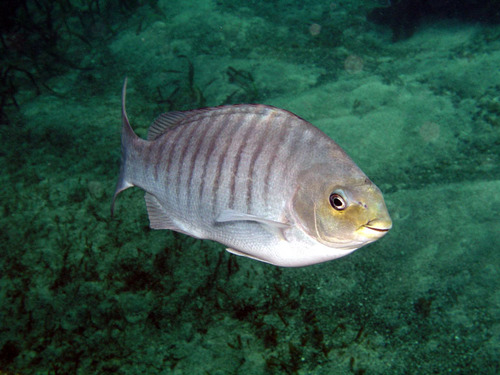
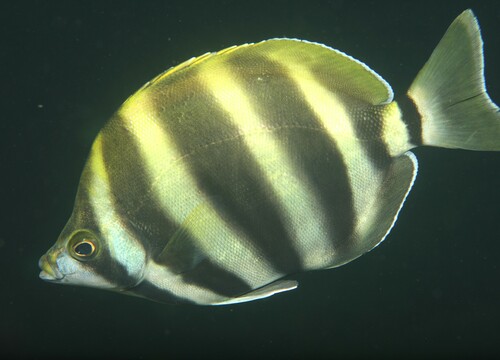
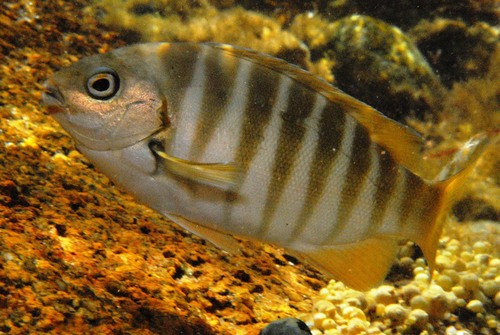
Girella zebra, first described by Richardson in 1846, has a moderately short, deep, compressed, oval body with a relatively thin caudal peduncle. Its head is small with a bulging forehead and small eyes. The mouth is small and does not reach the level of the front of the eye; the maxilla are hidden beneath the preorbital bones. Each jaw holds two rows of teeth: the outer row is made up of non-overlapping, flattened, tricuspid teeth, while the inner row consists of a wide band of tiny teeth that share the same shape as the outer row teeth. Most of the fish's body is covered in small ctenoid scales. The lateral line is continuous, holds 72 to 80 scales, and curves in parallel with the arch of the back. The dorsal fin is continuous, with almost no height difference between its spiny and soft-rayed sections. The spiny part has 14 spines and is roughly one-third longer than the soft-rayed part, which has 13 to 15 soft rays. The longest spines are located in the middle of the spiny section, and are marginally longer than the longest soft rays. The anal fin matches the soft-rayed part of the dorsal fin in both length and shape, and sits opposite the soft-rayed dorsal section. It has three spines and 11 soft rays. The caudal fin is large and broadly forked; the pectoral and pelvic fins are small, with the uppermost pectoral fin rays being the longest. Adult G. zebra have a pale body marked with nine or ten dark bars along the flanks that taper toward the ventral side, and pale yellow fins. Juveniles are darker with less distinct markings, and may be mistaken for luderick. This species reaches a maximum total length of 34 centimetres, or 13 inches. Girella zebra occurs in the Indian and western Pacific Oceans, and is endemic to southern Australia. Its range extends from the Clarence River in New South Wales south to Tasmania, along the entire southern Australian coast, and north up the western coast of Western Australia to Port Denison. This species typically inhabits rocky reefs in shallow coastal waters between 0 and 20 metres (0 to 66 feet) deep. It can also be found in sheltered offshore waters and in estuaries. G. zebra uses its flattened teeth and long narrow gill rakers to capture small prey. It is mainly a herbivore that feeds on seaweeds, but will also eat benthic invertebrates such as sea squirts, and it forms schools.