About Girella tricuspidata (Quoy & Gaimard, 1824)
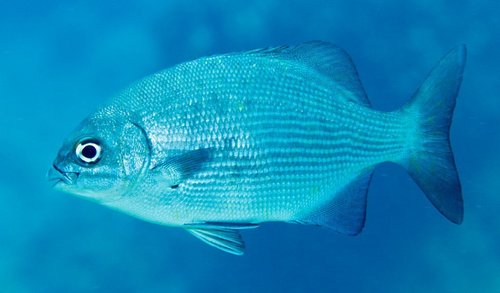
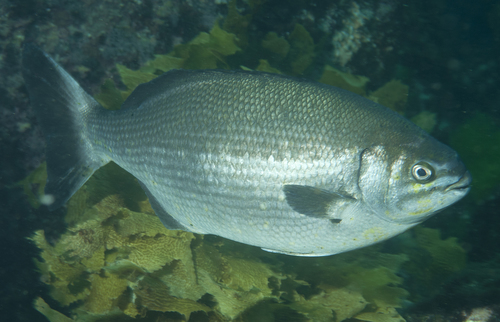
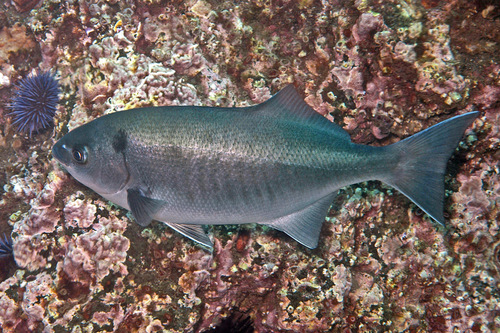
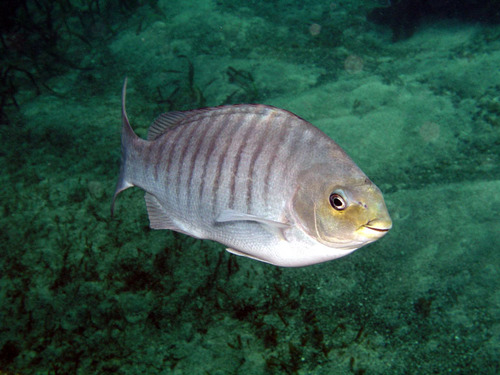
Girella tricuspidata was first formally described as Boops tricuspidatus in 1824 by Jean René Constant Quoy and Joseph Paul Gaimard, with the type locality given as Shark Bay, Western Australia. G. tricuspidata has a moderately deep, compressed, oval-shaped body with a thin caudal peduncle. It has a small head with a slightly convex forehead and small eyes. The mouth is small and does not extend as far as the eye. The jaws have an outer row of overlapping, flattened, tricuspid teeth next to a wide band of tiny teeth of the same shape. Most of the body is covered in moderately small ctenoid scales, and there is an arched lateral line made up of 48–51 pored scales that runs parallel to the dorsal profile. It has a continuous dorsal fin with no separation between its spiny and rayed sections. The spiny section has 14–16 spines and is one and a half times to almost twice as long as the soft-rayed section, which contains 11–12 soft rays. The spines in the middle of the dorsal fin are the longest, and are just slightly shorter than the soft rays, which become shorter towards the tail. The anal fin is similar to the soft-rayed part of the dorsal fin, has 3 spines and 11–12 soft rays, and sits opposite the soft-rayed dorsal section. The caudal fin has 17 rays, is very large, and broadly forked. The pectoral fins are small, with 16 rays, and the uppermost ray is the longest; the pelvic fins are also small, and contain one spine and 5 rays. The maximum recorded size is a fork length of 71 centimetres (28 in), though total lengths around 35 centimetres (14 in) are more typical. The maximum published weight is 4 kilograms (8.8 lb). G. tricuspidata is dark greenish-grey on its dorsal side, and silvery grey on the flanks, ventral side, and belly. There are around 11 thin dark vertical bars below the dorsal fin that fade toward the ventral side. The head and pectoral fins are sometimes yellowish, but most fins are usually the same colour as the part of the body they attach to. G. tricuspidata is found off the coasts of eastern Australia and New Zealand. In Australia, its range extends from Mackay, Queensland, to east of Adelaide in South Australia, and it also occurs off most of Tasmania. In New Zealand, it is found on both the east and west coasts of the North Island, from North Cape to the Cook Strait. G. tricuspidata lives in shallow coastal and estuarine waters, where it frequently forms large schools near rocky outcrops and jetties. Small juvenile G. tricuspidata use seagrass beds to hide from predators. This species uses its small sharp, incisor-like teeth to graze on seaweed and algae including Enteromorpha intestinalis, Ulva lactuca, Ulva intestinalis, and sea cabbage, and uses a band of crushing teeth to grind the algae. While it primarily eats algae, G. tricuspidata is an opportunistic omnivore that also feeds on other food items such as small crustaceans, pipi, mussels, and beach worms. As G. tricuspidata matures, it gathers in large shoals, and adults make 'runs' from estuarine waters and coastal lakes out into the sea. This fish spawns in the surf zone and at the mouths of estuaries, and spawning occurs in winter. G. tricuspidata forms schools during the day, and hides in sheltered areas at night, camouflaging itself by turning brown.