About Girella nigricans (Ayres, 1860)
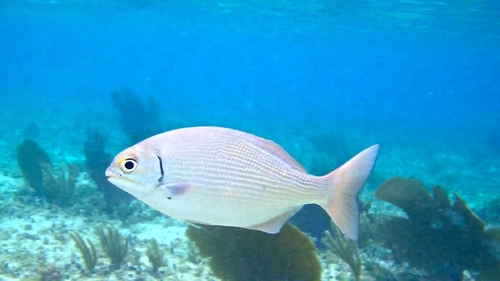
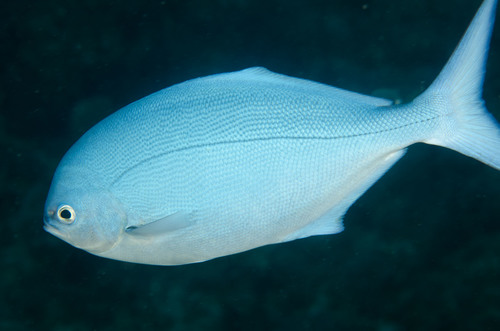
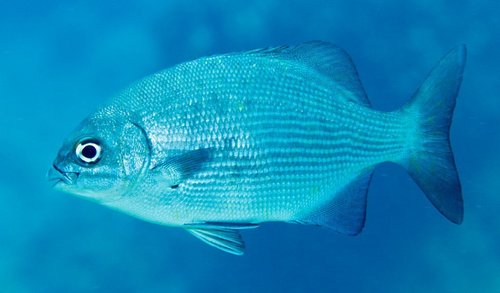
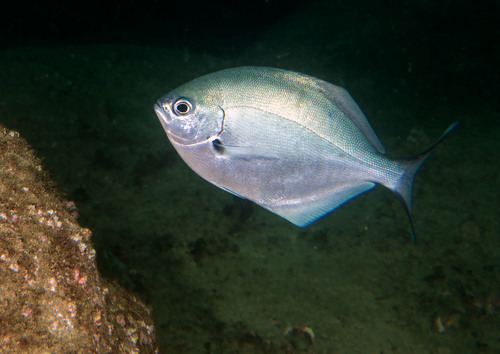
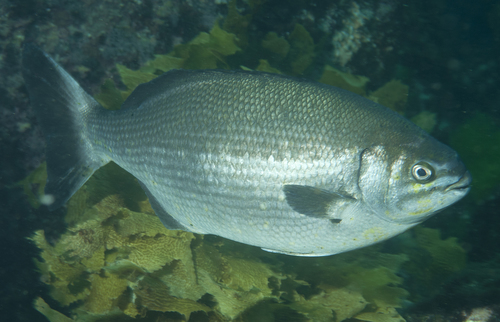
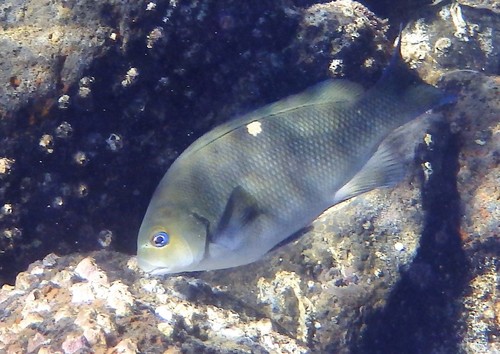
Girella nigricans, commonly called opaleye, has a laterally compressed, oval-shaped body. It has a blunt, short snout, with a small mouth that has thick lips positioned at the front of the head. This species is dentally polymorphic: some juveniles transition from having tricuspid teeth to having simple teeth. All of its fins are relatively short, with shapes ranging from rounded to blunt. Its dorsal fin is continuous, and its tail fin has a straight margin. The opaleye’s dorsal fin contains both spines and soft rays; the soft dorsal rays are either longer than the dorsal spines, or roughly equal in length. The dorsal fin has 12 to 14 spines along its anterior section and 12 to 15 soft rays along its posterior section. The anal fin has three spines and 10 to 13 soft rays. The paired pectoral and pelvic fins are relatively short. Living adult opaleye are colored grey-green to olive green, with two to six paler spots on the middle of their upper back. They usually have just one pair of white spots beneath the center of their dorsal fin, but can have more spots on each side. Opaleye with more than two spots are not uncommon, and this trait may come from gene flow with the related species Girella simplicidens, which has six spots. A white bar may be present between the opaleye’s eyes, and its eyes are an opalescent blue-green color. Juveniles have a bluish dorsal surface and a silvery ventral surface. This species can grow to a maximum total length of 66 cm (26 in) and reach a maximum weight of 13.5 pounds. Opaleye can be mistaken for another fish species, the halfmoon (Medialuna californiensis), which is also found in California and shares the opaleye’s habitat; juveniles of both species school together. Opaleye are endemic to the Eastern Pacific Ocean, with a geographic range that extends from San Francisco, California to Baja California, Mexico. They are most abundant in waters south of Point Conception. Adult opaleye live out their lives in kelp beds of the rocky subtidal zone, while juveniles live in the intertidal zone, most often in tidepools. Adults are most abundant at a depth of 20 feet. Opaleye are abundant within kelp forests, and contribute greatly to the health and productivity of kelp forest ecosystems. Since there are very few herbivorous fish species in the temperate waters of southern California, opaleye and halfmoon are important for maintaining kelp forest communities. They graze on algae in the kelp forest to keep algal populations balanced, preventing kelp from dominating the area. This balance supports the overall health of the kelp forest community, because it lets other species of algae and sessile invertebrates compete for available space. Opaleye also add to nutrient inputs in the ecosystem through their excretions. Opaleye are pelagic spawners: they release their eggs and larvae into open water, where they float freely. Spawning takes place in April, May, and June, typically in kelp beds. When they are young, opaleye migrate closer to shore in small schools of about two dozen individuals or fewer, most often moving into tidepools. For most young opaleye, this migration happens in late June, when the fish are around two months old and roughly one inch long. They remain in the intertidal zone for between one year and two or more years. Living in tidepools lets juveniles grow and develop without large predators, which do not live in this zone. Eventually, they return to deeper waters, where they mature and spawn, usually when they are two or three years old. Within a week of moving into the intertidal zone, young opaleye undergo both morphological and behavioral changes. They change color, from silver on the ventral and lateral surfaces and blue on the dorsal surface to olive green, and develop white spots on either side beneath the dorsal fin. They stop schooling and begin staying in areas where they can quickly hide under rocks to protect themselves from predators. They also shift their diet from feeding on plankton to a more herbivorous, algae-based diet. Opaleye can live up to ten years. Their fastest growth happens between ages zero and four, before they reach sexual maturity. After this point, their growth slows significantly, as energy is redirected to reproduction. Sagittal otoliths, structures located in a fish’s inner ear, are used to estimate the age of opaleye; the weight of these otoliths is also used for age estimation.