About Girella elevata Macleay, 1881
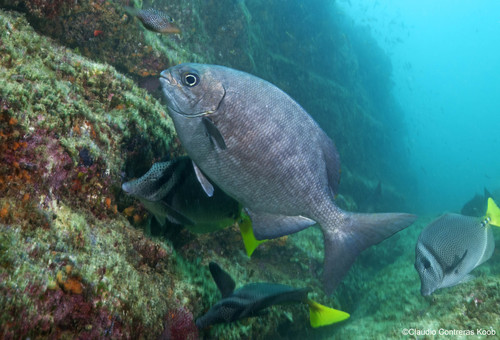
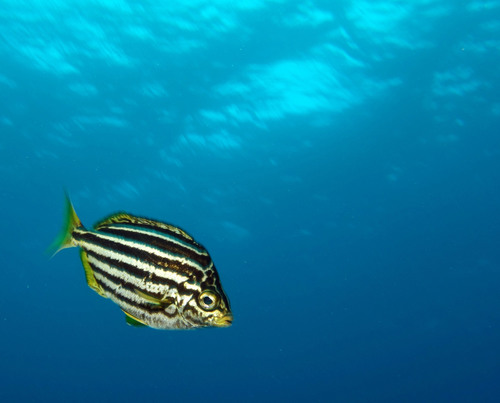
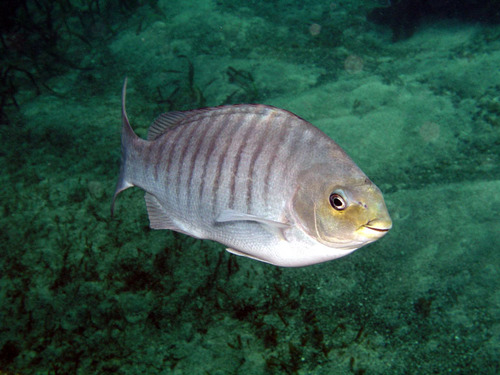
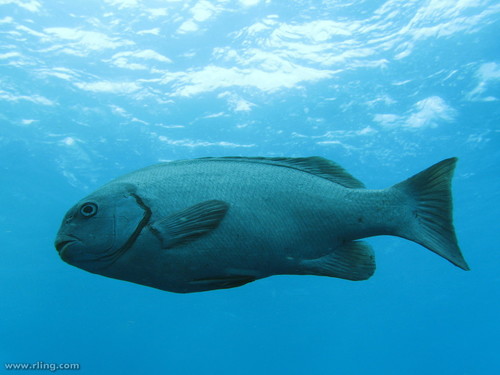
Girella elevata has a moderately deep, compressed oval-shaped body, a narrow caudal peduncle, and a small head with a slightly bulging forehead. It has a small mouth that does not extend as far as the eye. Each jaw has two rows of teeth: an outer row of flattened three-crowned teeth that do not overlap, and an inner row of similar, much smaller teeth. Most of the body is covered in ctenoid scales, and it has a continuous lateral line that arches in parallel with the body's dorsal profile. The dorsal fin is continuous, with almost no difference in form between its spiny and rayed parts. The spiny portion is about one-third longer than the rayed portion; spines become longer toward the tail, and soft rays are noticeably longer than the spines. The soft-rayed part of the dorsal fin is rounded. The anal fin matches the shape of the soft-rayed part of the dorsal fin and lies opposite it. Girella elevata has a very large, deeply forked caudal fin. Its pectoral fins are small, with the upper rays being the longest, and it has small pelvic fins located below, and just to the rear of, the base of the pectoral fins. The dorsal fin has 14-16 spines and 11-12 soft rays, while the anal fin has three spines and 11-12 soft rays. This species can reach a standard length of 62 centimetres (24 in), and has an average standard weight of 1 kilogram (2.2 lb) to 2 kilograms (4.4 lb), though individuals can exceed 3 kilograms (6.6 lb). Adults are uniformly blackish-brown to grey, with a black margin along the posterior edge of the operculum. Juveniles are less uniformly coloured and more mottled, as their dark colour is broken by bands on the back. This species can be confused with the silver drummer (Kyphosus sydneyanus), and may also be mistaken for the related species dusky sea chub (Girella freminvillii), which occurs in the Galápagos Islands. Girella elevata was first formally described by William John Macleay in 1881, with the type locality given as Port Jackson, New South Wales. This species is found in the south-western Pacific Ocean, in coastal eastern Australia and northern New Zealand. In Australia, it occurs from Noosa Heads, Queensland south to Apollo Bay in Victoria and northern Tasmania, and it is rare west of Wilsons Promontory in Victoria. It is also found around Lord Howe Island in the Tasman Sea. While Girella elevata has been reported in waters off Japan, these records most likely refer to Girella leonina or Girella punctata; both of these species include "blackfish" in their Japanese names, and are primary targets for Japanese recreational fishers, who sometimes charter helicopters for day trips to offshore islands to fish for them. Adult Girella elevata prefer rocky reef areas in exposed situations, where they can be found from the surf zone down to around 25 metres (82 ft). They are frequently seen by divers in caves or under ledges. Juveniles live in rockpools, estuaries, and shallow rocky reef areas. This species may live as long as 45 years. It is omnivorous, feeding on a range of invertebrates and algae.