About Girella cyanea Macleay, 1881
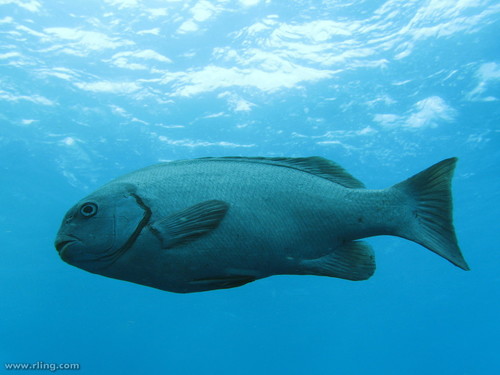
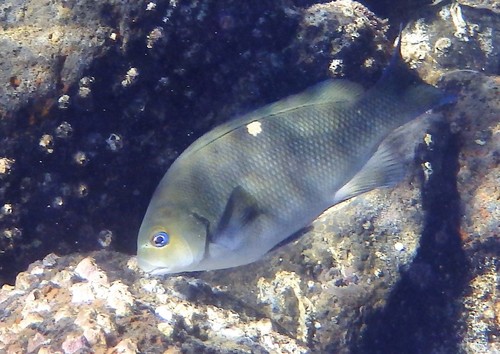
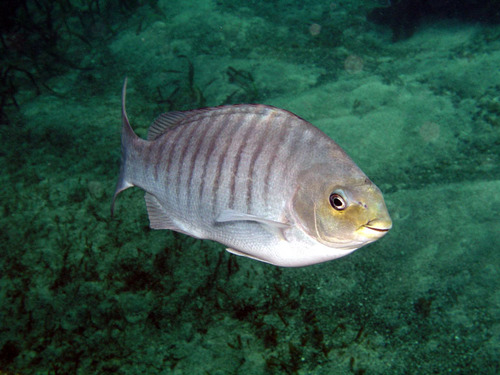
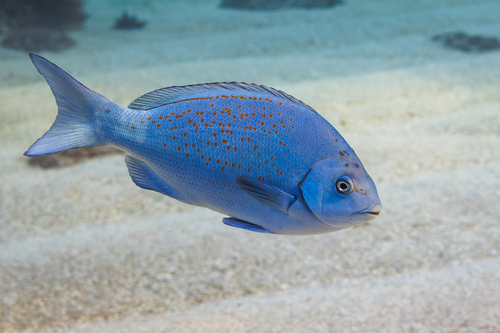
Girella cyanea can be recognized by its blue coloration and yellow spots, and its blueish color becomes a greyish-green after death. Adults of this species can reach a length of 76 cm, and their bright flank spots are distinctive. Younger individuals are greeny-grey in colour, with paler yellow spots. These fish have a small beak-like mouth and large scales. Sea chubs are easily recognized by distinct morphological characteristics, including ovate-shaped bodies, small mouths, and a weakly-forked, strong caudal fin. Another key characteristic is a spinous dorsal fin with low spines, followed by a higher, evenly curved or falcate soft dorsal fin. Girella cyanea is commonly found in the south-west Pacific Ocean, occurring along the east coast of Australia from Flinders Reef off Cape Moreton in Queensland to Eden in southern New South Wales. The species can also be found at Elizabeth and Middleton Reefs, Lord Howe and Norfolk Islands, and New Zealand's North and Kermadec Islands. These bluefish live in the ocean and do not generally enter rivers or estuaries. Juveniles live in tidal pools until they reach adulthood, after which they form schools over reef areas. Adults are typically found in coastal and offshore rocky reef areas in New South Wales, at depths ranging from 5–30 metres (16–98 ft). Girella cyanea is omnivorous, and is known to eat crustaceans, smaller fishes, and mollusks, along with calcareous seaweeds, brittle stars, cunjevoi, and marine worms. They feed at dawn and dusk, when they are most active. An ontogenetic diet shift has been observed in fish under 40 millimetres (1.6 in) standard length. Individuals found in intertidal habitat have a mainly carnivorous diet and a digestive system without developed pyloric caeca. In contrast, pyloric caeca are well-developed in fish larger than 40 millimetres (1.6 in), and these larger individuals ingest increased amounts of algae. Girella cyanea is a fast-growing and long-lived fish, with the oldest observed specimen being 41 years old. It is believed that individuals reach sexual maturity between 2 and 5 years of age, or when they reach 200 millimetres (7.9 in) in length.