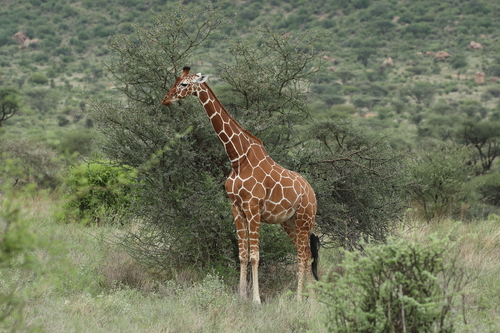
About Giraffa reticulata de Winton, 1899
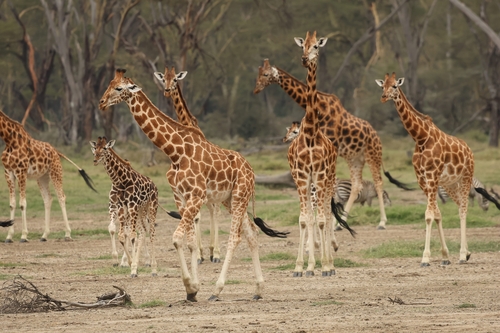
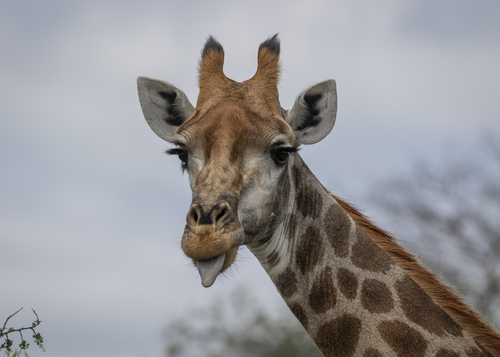
The reticulated giraffe, also called the Somali giraffe, has the scientific name Giraffa reticulata de Winton, 1899. It is a giraffe species native to the Horn of Africa. Its coat sets it apart from other giraffe species: it is made up of large, polygonal or squared, block-shaped spots that extend all the way to the lower legs, tail, and face. These distinct liver-red spots also have far less white space between them than spots on other giraffe species. Reaching up to 6 meters in height, the reticulated giraffe is the largest giraffe species and the tallest land animal overall. Though reticulated giraffes still occur in parts of their historic range, such as areas of Somalia and Ethiopia, their main population stronghold is in Kenya. Around 8,500 reticulated giraffes live in the wild. As of 2024, the total global population, including both wild and captive individuals, is 15,785. Reticulated giraffes can interbreed with other giraffe species in captivity, and also in the wild if they come into contact with other giraffe species such as the Masai giraffe (G. tippelskirchii). Alongside Masai giraffes and Baringo (also called Rothschild's) giraffe (G. c. rothschildi), reticulated giraffes are one of the most common giraffe species kept in animal parks and zoos.
Historically, reticulated giraffes ranged widely across Northeast Africa. Their preferred habitats are acacia-dotted savannas, arid woodlands, seasonal floodplains, semi-deserts, steppes, and open forest. Today, they are most often found in Kenya, in protected areas including Meru National Park and Samburu National Reserve, and generally across the northern side of Mount Kenya. They have also been observed as far out as Habaswein, Mnazini, and Wajir, as well as in Tsavo East National Park.
Reticulated giraffes are diel, meaning they are active during both the day and night. They are most active in the early and late parts of the day — at dawn and dusk — and at midnight, as an adaptation to their warm habitat; this activity pattern can also be described as crepuscular. Their sleeping periods are usually short, lasting no more than a couple hours at a time, and they typically sleep standing up. The home ranges of individual reticulated giraffes are nonexclusive and usually overlap with the ranges of other individuals or groups. Home ranges include both males and females, and their size changes based on food resources, gender, and water availability. There is no evidence that reticulated giraffes exhibit territorial behavior.
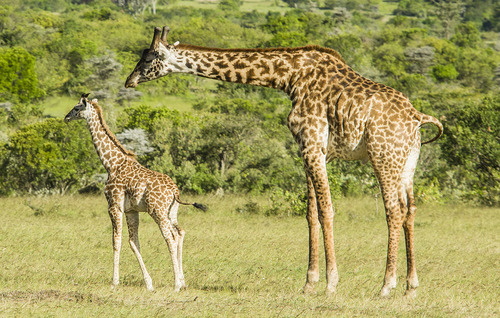
For reproduction, female reticulated giraffes signal they are receptive to mating by releasing odor from their vaginal area and hindquarters. A female's estrous cycle lasts approximately 15 days. Males detect this scent by curling their lip, which helps draw the odor to the giraffe's vomeronasal organ. Dominant males guard females in estrus to keep other competing males away. When a male is ready to mate, he alerts the female by tapping her hind leg with his foreleg, or by resting his head on the female's back. After mating, males and females do not form any long-term bond. The average gestation period for reticulated giraffes ranges from 146.6 days to 15 months, and most pregnancies produce a single offspring. Twin births are rare but have been documented. Females give birth standing up, and newborn calves can stand between 5 and 20 minutes after birth. Weaning age for young giraffes ranges from 6 to 17 months, and calves become independent at 2 years old.