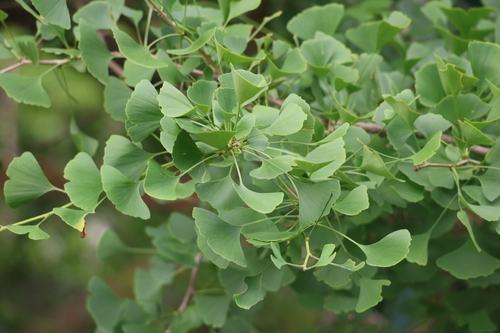
About Ginkgo biloba L.
Ginkgo biloba L. are large trees that typically grow 20–35 m (66–115 ft) tall, with some specimens in China reaching over 40 m (131 ft). The species has an angular crown and long, somewhat irregular branches, and is usually deep-rooted and resistant to wind and snow damage. Young ginkgo trees are often tall, slender, and sparsely branched, and their crown broadens as they age. A combination of disease resistance, insect-resistant wood, and the ability to form aerial roots and sprouts makes ginkgos very long-lived: some specimens are estimated to be over 3,500 years old.
Although Ginkgo biloba and other species in the genus Ginkgo were once widespread across the globe, their natural range had shrunk by two million years ago. For centuries, G. biloba was thought to be extinct in the wild, but it is now commonly cultivated across eastern China, Korea, and Japan. Many municipalities in these three countries use ginkgos as street trees, and ginkgo leaves are the emblem of major educational institutions including the University of Tokyo and Sungkyunkwan University in South Korea. Despite its widespread cultivation, ginkgo trees have very high genetic uniformity. Some Chinese scholars have suggested that ginkgo populations in these cultivated areas may have been planted and preserved by Chinese monks over the past roughly 1,000 years. Studies have found greater genetic diversity in ginkgo populations in Southwestern China, which supports the existence of glacial refugia in the mountains surrounding the eastern Tibetan Plateau, where several old-growth populations that may be wild have been reported. It has not been definitively proven whether native wild ginkgo populations still exist, but genetic evidence suggests these Southwestern populations may be wild, and also that the largest and oldest G. biloba trees may be older than the human settlements surrounding them. In areas where wild G. biloba occurs, it is found rarely in deciduous forests and valleys on well-drained acidic loess, a fine, silty soil. Wild ginkgo habitat typically has soil pH between 5.0 and 5.5. While cultivated ginkgo specimens can survive in a range of environments including subtropical climates, wild ginkgo is native to mostly temperate climate regions.
Ginkgo biloba is dioecious, meaning individual trees are either male or female. Male trees produce small pollen cones with sporophylls, each of which holds two microsporangia arranged in a spiral around a central axis. Sex conversion, where some branches on a single tree change sex, has been observed. This phenomenon is hard to study because it is rare, and because grafting female branches onto male rootstock was a common practice in 19th century Europe. Female trees do not produce cones. They form two ovules at the end of a stalk. Pollination happens via wind, and fertilization of the ovule uses motile sperm, just like in cycads, ferns, mosses, and algae. Ginkgo sperm are large, around 70–90 micrometres, and similar in structure to the slightly larger sperm of cycads. Ginkgo sperm was first discovered by Japanese botanist Sakugoro Hirase in 1896. The sperm have a complex multi-layered structure, with a continuous belt of basal bodies that form the base of several thousand flagella which move in a cilia-like pattern. This flagella/cilia structure pulls the sperm body forward. Sperm only need to travel a very short distance to reach the archegonia, of which there are usually two or three per ovule. Each ovule produces two sperm, and one successfully fertilizes the ovule. Fertilization of ginkgo ovules, and embryo development, happens just before or after the ovules fall from the tree in early autumn.
The genus Ginkgo has a very slow evolutionary rate. It is possible that Ginkgo represents a pre-angiosperm survival strategy for disturbed streamside environments. Ginkgo evolved before flowering plants, when ferns, cycads, and cycadeoids dominated disturbed streamside environments and formed low, open, shrubby canopies. Ginkgo's large seeds and "bolting" habit – growing to 10 meters in height before elongating its side branches – may be adaptations to this type of environment. Modern G. biloba grows best in well-watered, well-drained environments, and fossil Ginkgo specimens that are extremely similar to modern plants favored the same conditions: sediment records from most fossil Ginkgo sites show it primarily grew in disturbed environments such as along streams. Because of this, Ginkgo presents an "ecological paradox": while it has some traits that suit it for living in disturbed environments, such as clonal reproduction, many of its other life history traits are the opposite of those seen in modern plants that thrive in disturbed settings, including slow growth, large seed size, and late reproductive maturity.
Since 2016, G. biloba extract has been classified as a possible human carcinogen (group 2B) by the International Agency for Research on Cancer. When eaten in large quantities or over a long period of time, ginkgo seeds may cause poisoning from ginkgotoxin (4'-O-methylpyridoxine, MPN), which has been documented in a small number of case reports. MPN is a heat-stable compound that is not destroyed by cooking, and according to limited studies, it may cause convulsions that can be alleviated by treatment with pyridoxine phosphate (vitamin B6). Some people are sensitive to chemicals in the sarcotesta, the outer fleshy coating of ginkgo seeds. These people should handle seeds carefully, wearing disposable gloves, when preparing them for eating. Symptoms include allergic contact dermatitis or blisters similar to those caused by contact with poison ivy.
Side effects from ginkgo supplements may include increased bleeding risk, gastrointestinal discomfort, nausea, vomiting, diarrhea, headaches, dizziness, heart palpitations, and restlessness. While using moderate amounts of standardized Ginkgo biloba leaf extracts appears to be safe, excessive use may cause unwanted effects, particularly in terms of drug interactions. Use of ginkgo supplements can interfere with the dosing of anticoagulants such as warfarin or antiplatelet medication. According to a systematic review, ginkgo use may increase bleeding time in pregnant women, and there is insufficient information about its safety during lactation. Ginkgo pollen can cause allergic reactions.
Ginkgo biloba leaves and sarcotesta contain ginkgolic acids, which are highly allergenic long-chain alkylphenols such as bilobol or adipostatin A. Bilobol is related to anacardic acid from cashew nut shells and urushiols found in poison ivy and other Toxicodendron species. People with a history of strong allergic reactions to poison ivy, mangoes, cashews and other alkylphenol-producing plants are more likely to have an allergic reaction when they consume non-standardized ginkgo-containing preparations. The former Federal German Health Authority's Commission Restricted the level of these allergens in standardized pharmaceutical Ginkgo biloba preparations to 5 ppm. Overconsuming Ginkgo biloba seeds can deplete vitamin B6.
Although G. biloba leaf extracts are often marketed as cognitive enhancers, there is no evidence that they affect memory or attention in healthy people. Systematic reviews have found no evidence that ginkgo extract is effective for treating high blood pressure, menopause-related cognitive decline, tinnitus, post-stroke recovery, or altitude sickness. According to a 2023 review, G. biloba and its extracts are not approved as a drug in the United States and do not have enough clinical evidence to support use as a medical therapy. The United States National Center for Complementary and Integrative Health concludes that despite extensive research, ginkgo has not been conclusively proven effective for any health condition, including dementia, cognitive decline, or other disorders it is commonly marketed to treat. A 2021 umbrella review concluded that G. biloba may be useful and safe for improving cognitive function and daily living activities in people with Alzheimer's disease. A 2018 review concluded that 22- to 24-week treatment with a G. biloba extract improved behavioral and psychological symptoms of dementia, and reduced caregiver distress compared to placebo. A 2017 overview of systematic reviews concluded that G. biloba extract may modestly improve cognitive function and daily living in dementia when taken at doses over 200 mg per day for at least 22 weeks. A 2016 systematic review concluded that G. biloba extract reduced tardive dyskinesia symptoms in people with schizophrenia and is generally safe. In 2014, the Committee on Herbal Medicinal Products of the European Medicines Agency concluded that powdered ginkgo leaf extract is effective and safe for improving cognitive function and quality of life in people with mild dementia, and licensed it as a medicine in EU member states.
Ginkgo has been cultivated in China for a long time, and is common in the southern third of the country. Some ginkgo trees planted at temples are believed to be over 1,500 years old. The first recorded encounter of ginkgo by Europeans was in 1690, when German botanist Engelbert Kaempfer saw the tree in Japanese temple gardens. Because of its significance in Buddhism and Confucianism, ginkgo has been widely planted in Korea and Japan since the 14th century, and some naturalization has occurred in both areas, with ginkgos self-seeding into natural forests. Ginkgo has been commonly cultivated in North America for over 200 years and in Europe for close to 300 years, but has never become significantly naturalized in these regions during that time. G. biloba is also commonly planted by hand in cities across the United States and Europe. This species is highly tolerant to pollution, and works as an attractive, shade-providing tree for many cities and gardens. Many intentionally planted ginkgos are male cultivars grafted onto seed-grown rootstock, because male trees do not produce bad-smelling seeds. The popular cultivar 'Autumn Gold' is a clone of a male plant. The downside of male Ginkgo biloba trees is that their pollen is highly allergenic. They have an OPALS (Ogren Plant Allergy Scale) rating of 7 out of 10, while female trees, which produce no pollen, have an OPALS allergy scale rating of 2. Female cultivars include 'Liberty Splendor', 'Santa Cruz', and 'Golden Girl' – the last is named for the striking yellow color of its leaves in autumn, and all female cultivars produce zero pollen. Many cultivars are listed in UK literature, and the compact cultivar 'Troll' has received the Royal Horticultural Society's Award of Garden Merit. Ginkgos adapt well to urban environments, tolerating pollution and confined soil spaces. They rarely have disease problems, even in urban conditions, and are attacked by very few insects. Ginkgos are popular for growing as miniature penjing and bonsai landscapes; they can be kept artificially small and tended for centuries. The trees are easy to propagate from seed.
The wood of Ginkgo biloba is used to make furniture, chessboards, carved items, and casks for making saké. The wood is fire-resistant and slow to decay. Ginkgo has been used in traditional Chinese medicine since at least the 11th century CE. Ginkgo seeds, leaves, and nuts have traditionally been used to treat a range of ailments including dementia, asthma, bronchitis, and kidney and bladder disorders. However, there is no conclusive evidence that ginkgo is useful for any of these conditions.

