About Gillichthys mirabilis Cooper, 1864
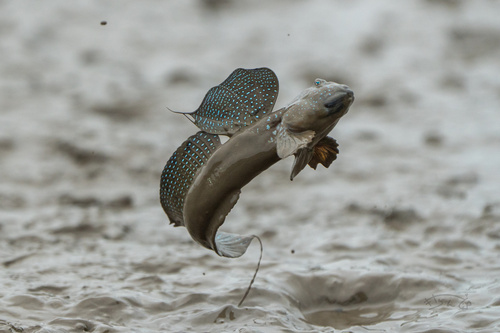
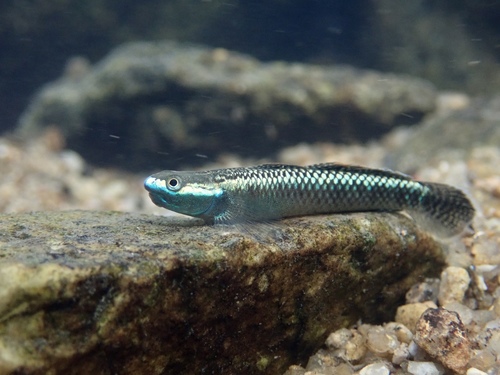
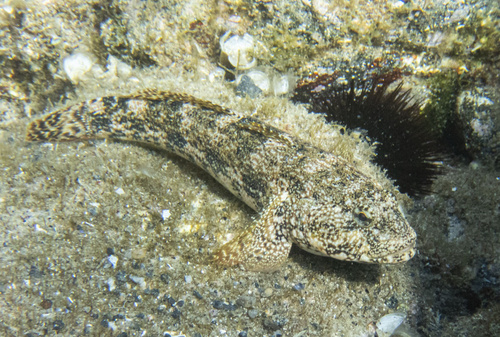
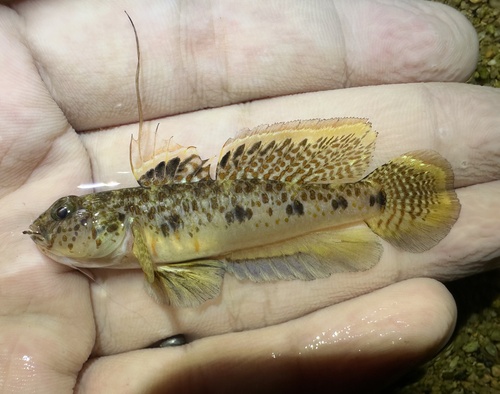
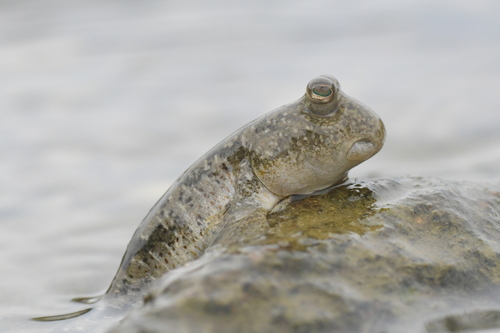
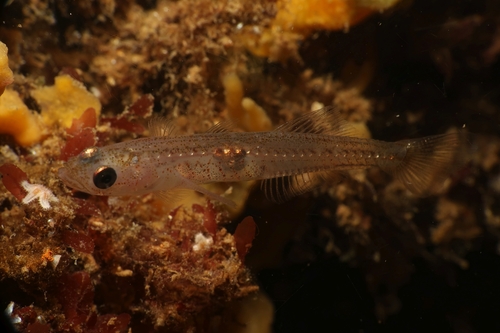
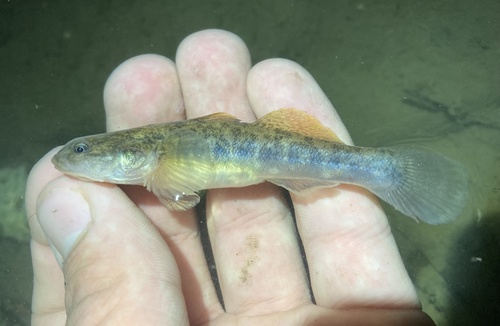
Gillichthys mirabilis, commonly called the longjaw mudsucker, has an elongated body and distinctive long jaws that give it its common name. Adult longjaw mudsuckers reach a maximum total length of approximately 150 mm, and most individuals are most commonly observed at 135–140 mm standard length. This species has a blunt head with small, widely spaced eyes that are positioned closer to the sides of the head in juveniles. It has a large terminal mouth: in adults the upper jaw extends nearly to the opercular opening, while in juveniles it reaches the rear margin of the eye. G. mirabilis has a relatively heavy body, two separate dorsal fins, and coloration that ranges from dark brown to olive across the back and sides, with a yellowish belly. Juveniles usually have eight faint vertical bars along their sides and a dark blotch on the posterior part of the first dorsal fin. The first dorsal fin has 4–8 spines, and the second dorsal fin has 10–17 rays. The anal fin contains 9–17 rays. The pectoral fins are broad and rounded, with 15–23 rays. Like many gobies, the pelvic fins of G. mirabilis are fused together to form a suction cup that helps the fish attach to surfaces. Its lateral line has 60–100 small scales; scales are absent from the front of the belly and become more prominent toward the caudal peduncle. Longjaw mudsuckers live in estuaries, especially tidal sloughs with shallow, mud-covered bottoms, where they often dig burrows. When tide recedes and mud becomes exposed, the fish retreat into their burrows or move into tidal channels. If they become trapped on exposed mud, they can gulp air into the buccopharyngeal chamber in their throat to survive until the next high tide. Their diet includes a wide variety of prey found in mud, with invertebrates making up the majority of their food; they may also eat small fish such as California killifish. Their feeding choices depend largely on seasonal prey availability, and they adapt to the resources present in their habitat. The native range of the longjaw mudsucker extends from Tomales Bay in northern California to Bahía Magdalena in Baja California Sur. A geographically separate population lives in the northern Gulf of California, and this population has evolved independently from the California and western Baja populations for approximately 284,000 years. This species has also been recorded outside its native range at sites including Roosevelt Lake on the Salt River in Arizona and the Salton Sea in California. It was likely introduced to the lower Colorado River in the Arizona-California-Nevada region, where it is commonly used as a bait minnow.