About Gila orcuttii (Eigenmann & Eigenmann, 1890)
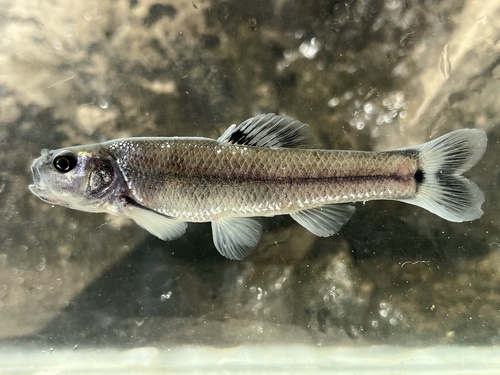
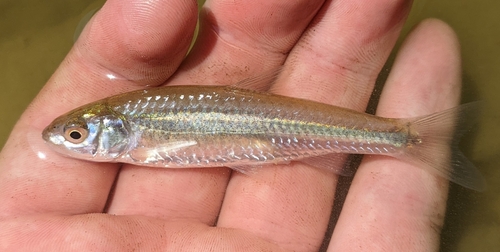
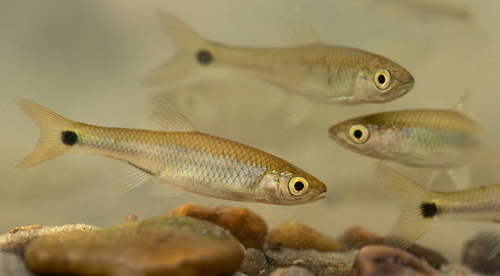
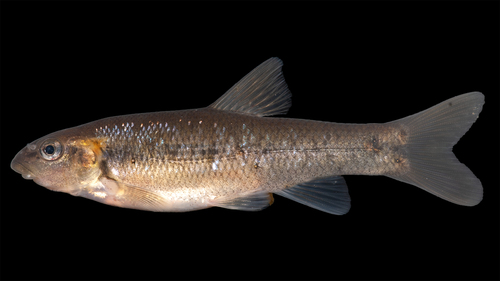
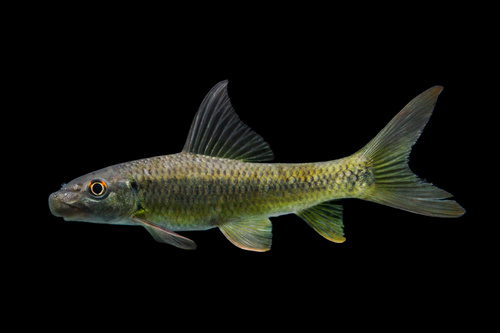
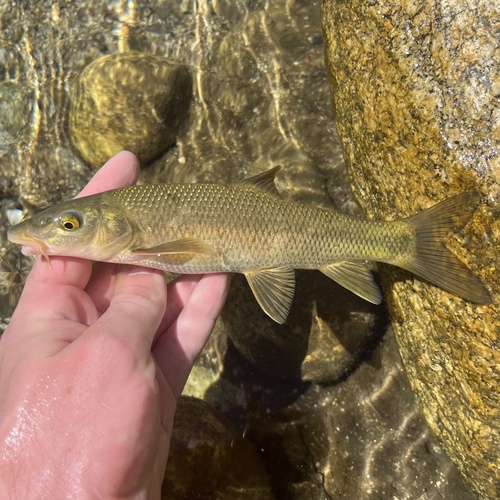
The Arroyo chub, scientifically named Gila orcuttii (Eigenmann & Eigenmann, 1890), is a small to moderately small fish with a robust, fusiform body and a thick caudal peduncle. It has a rounded snout, a terminal to slightly subterminal mouth, and proportionally large eyes. Its dorsal surface is typically olive or gray, transitioning to silver or white on the ventral side, and many individuals have a faint lateral stripe. Like other cyprinids, it has a single dorsal fin, plus pectoral, pelvic, anal, and forked caudal fins; the dorsal fin has 8 rays, while the anal fin has 7 rays. During the spawning season, males often develop enlarged fins and breeding tubercles on their pectoral fins. Most adult Arroyo chub measure 7–10 cm (2.8–3.9 in), and larger individuals can reach close to 12 cm (4.7 in).
Arroyo chub is native to coastal streams of Southern California, and occurs primarily in Los Angeles, Orange, Riverside, and San Diego counties. Its native range includes drainages of the Los Angeles River (including the Arroyo Seco), San Gabriel, Santa Ana, San Juan, Malibu, Santa Margarita, and San Luis Rey systems. Recent surveys found the species in 18 of 40 sampled streams across all seven of its historically occupied watersheds, though it is often restricted to upper or less-disturbed stream reaches. Human-mediated introductions of Arroyo chub have been recorded in the Santa Ynez, Santa Maria, Cuyama, Santa Clara, and Mojave River drainages. These introductions are thought to come from bait bucket releases and accidental transfers that happen during trout stocking.
Arroyo chub is a habitat generalist, able to thrive in a wide range of environmental conditions rather than being limited to a narrow set of habitat types. Even so, it tends to prefer flowing pools, runs, and slow to moderate current zones in small to medium-sized streams with sandy or muddy substrates. The species can tolerate warm temperatures, hypoxic summer conditions, and high-flow winter periods, with a reported thermal tolerance range of approximately 10 to 24–26 °C (50 to 75–79 °F). Arroyo chub are most often found in deeper pool habitats that are over 40 cm (16 in) deep, particularly pools that offer vegetative cover or shelter. They can also survive in intermittent streams, living in remnant pools during dry periods.