About Gigantometrus swammerdami (Simon, 1872)
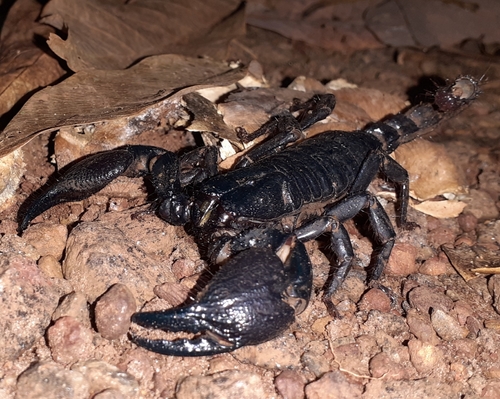
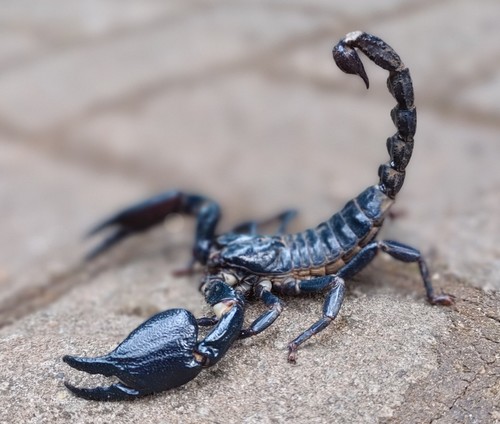
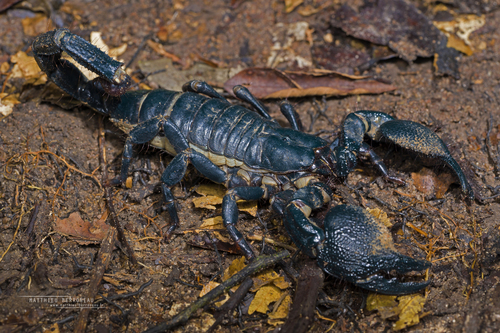
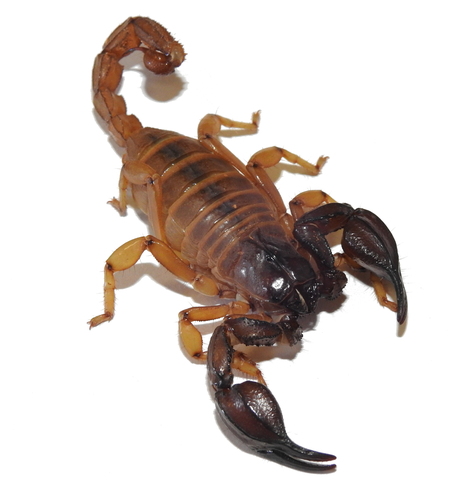
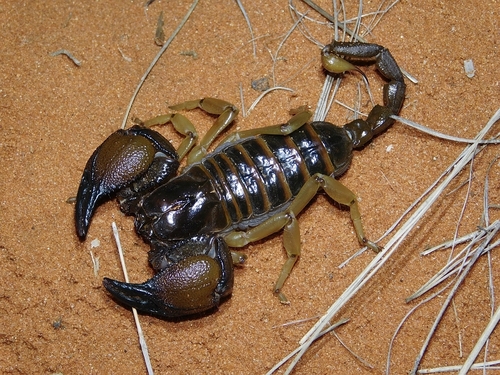
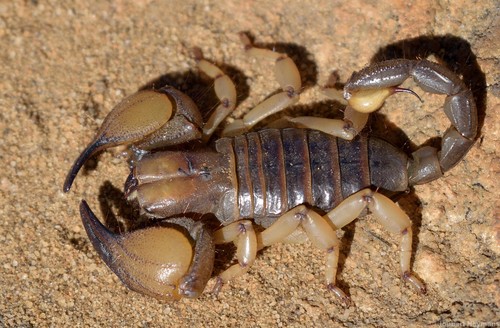
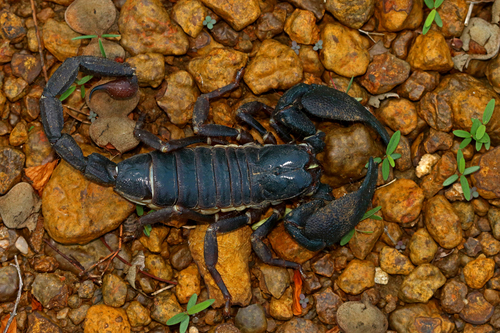
The body of Gigantometrus swammerdami ranges in color from uniform reddish brown to reddish black. Juveniles are typically reddish, with a yellow telson (stinger). This species has between 16 and 20 pectinal teeth. Its chela (claws or pincers) are strongly lobiform, or lobe-shaped, and are entirely covered by large rounded granulae, or bumps. The pedipalp patella, the joint that directly connects the pincers to the scorpion's arms, lacks a pronounced internal tubercle. The scorpion's carapace, the outer shell covering its back, is composed of smooth discs, while its edges and rear portions have a textured surface. Its telson, which holds both the stinger and the venom container, is bulbous, and the vesicle (the venom container portion of the telson) is longer than the aculeus (the stinger itself). The neurosecretions of this species have been largely identified. In ecological terms, the venom of Gigantometrus swammerdami is not usually lethal to humans. This is likely because the species is thought to have evolved to kill prey by crushing it with its pincers, rather than using venom. This giant forest scorpion is most often found in tropical rainforests and other habitats with moderately warm climates. Specimens have been collected from inside degraded or semi-degraded termite mounds, tree holes, and abandoned rat or crab holes in the bunds of agricultural fields. Males are typically active during the summer season, from April to July, when solitary individuals leave their dens to move about.