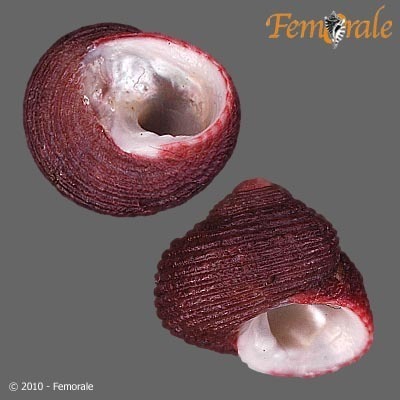
About Gigahomalopoma luridum (Dall, 1885)
The shell of Gigahomalopoma luridum ranges in height between 6 mm and 10 mm. Shell color can be red, ashen, or purple. The small, globose shell is very solid and imperforate. It has a conic spire that is more or less depressed, with a moderately impressed suture. There are five slightly convex whorls; the final whorl is decidedly deflected toward the aperture, and encircled by around fifteen subequal spiral lirae, separated by interstices that are roughly as wide as the ridges. Incremental striae are generally strongly developed, which makes the lirae appear nodose or somewhat irregular, and causes the interstices to look pitted. The oblique aperture is pearly white on the inside, and measures approximately half the total length of the shell. The columella is arcuate. The base of the shell is obsoletely uni-, bi-, or tridentate. The rounded oval operculum is nearly smooth and slightly concave in the middle. This species occurs in abundant numbers in the Pacific Ocean, found under rocks and on shale at low tide, ranging from Sitka, Alaska to Northern Baja California, Mexico.

