About Gibbonsia montereyensis Hubbs, 1927
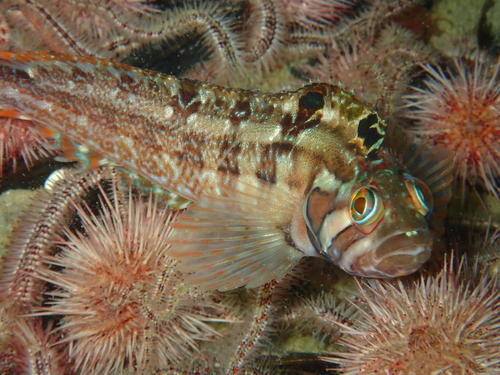
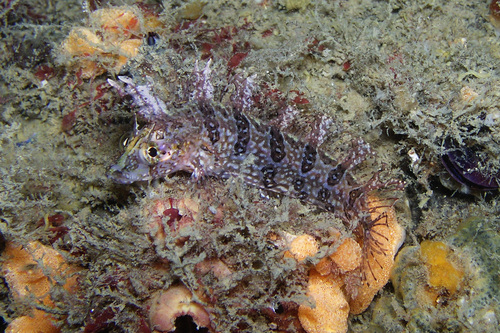
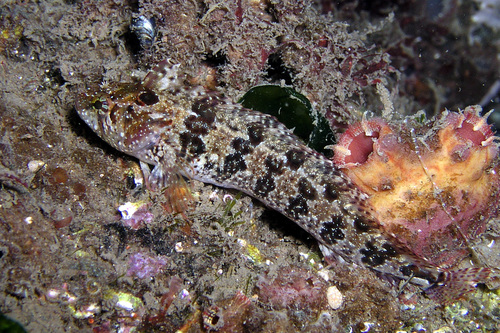
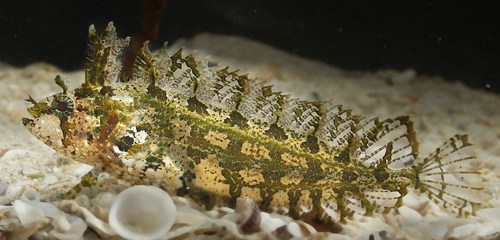
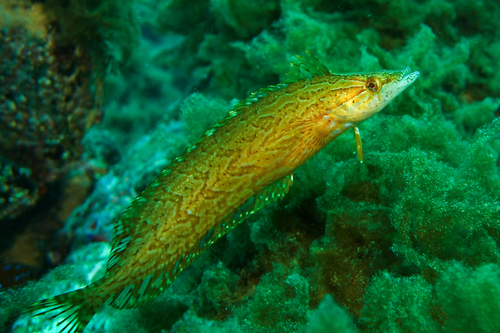
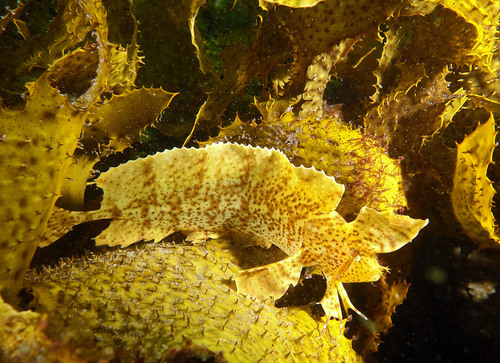
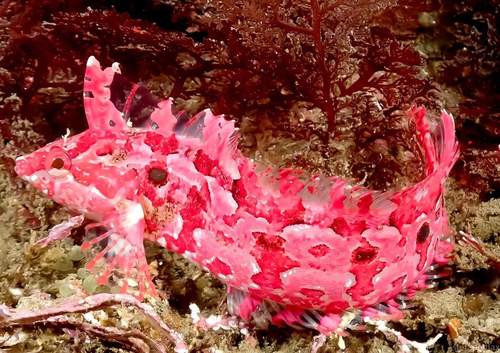
The crevice kelpfish, with the scientific name Gibbonsia montereyensis Hubbs, 1927, is a species of ray-finned blenny from the family Clinidae and the genus Gibbonsia. The genus Gibbonsia has three recognized species: G. montereyensis, G. elegans, and G. metzi. This species occurs in coastal waters of the eastern Pacific Ocean, ranging from British Columbia to central Baja California. South of Point Conception, crevice kelpfish are only found on offshore islands and portions of Baja California where upwelling maintains cold water temperatures. They are only occasionally encountered in tidepools, since they prefer deeper water than other members of the genus Gibbonsia. They typically inhabit areas from the intertidal zone to the subtidal zone at depths up to 20 meters, and favor rocky, algae-covered habitats on exposed coasts, especially locations with abundant seagrass and algal growth. Gibbonsia montereyensis is a small marine fish that reaches a maximum total length of around 11 centimeters, making it the smallest species in its genus. It has an elongated, laterally compressed body covered in small cycloid scales, with relatively small pelvic and caudal fins. A distinguishing feature that separates G. montereyensis from other members of the genus Gibbonsia is the absence of scales on its caudal fin. Crevice kelpfish have a continuous dorsal fin that stretches from the head to the caudal peduncle, with 34 to 36 spines and 5 to 8 soft rays. The dorsal spines near the head are longer than the other spines, which gives the fish a crested appearance on its head. Like other kelpfish, G. montereyensis has fleshy, hairlike cirri (tufts) above its eyes. Its elongated anal fin contains 34 to 36 spines and 5 to 8 soft rays. Pelvic fin spines are separate from the main pelvic fin and positioned slightly in front of the main fin. The mouth is small and terminal, lined with small, fixed, conical teeth. This species often displays coloration that matches its surrounding environment, and it has high color variability that can include brown, reddish, dark green, and silver. The typical color pattern consists of dark vertical bars along the length of the body, scattered dark spots, and a dark ocellus above the lateral line, behind the pectoral fin. The genus Gibbonsia is sexually dichromatic, with males and females differing in belly color. Crevice kelpfish are capable of changing color, but no definitive studies have been published on the timing or mechanism of this color change. Related species like G. elegans can change color over the course of several weeks, and this change is thought to be independent of diet. For G. montereyensis, color often varies with season: individuals are commonly red in winter, when red algae dominates the habitat, and green in spring, when green algae dominates. G. montereyensis is also susceptible to chromotaforma, a tumor of pigment cells that develops in the skin layer. In ecology, crevice kelpfish spend most of their time anchored to algae-covered rocks using their pectoral spines, and use their variable coloration to successfully camouflage against surrounding algae. They do not have high mobility, and are a common prey item for larger marine predators, so their camouflage is an important defensive adaptation. They are benthic invertebrate feeders, and their diet includes isopods, amphipods, crabs, copepods, shrimps, limpets, mollusks, fish eggs, and polychaetes. The International Union for Conservation of Nature (IUCN) lists G. montereyensis as a species of Least Concern. However, research indicates that crevice kelpfish will likely be negatively affected by warming ocean temperatures, since they prefer cold water. They have some tolerance to warmer water, but less tolerance than other species in the genus Gibbonsia. One study found that G. montereyensis is less adaptable to both cold and warm water than congener Gibbonsia metzi. Heat stress can cause rapid death if water temperatures rise above the species' tolerable range. A new type of parasitic copepod has been found on two other Gibbonsia species, and may affect G. montereyensis in the future, though it has not yet been recorded on this species.