About Gibbonsia elegans (Cooper, 1864)
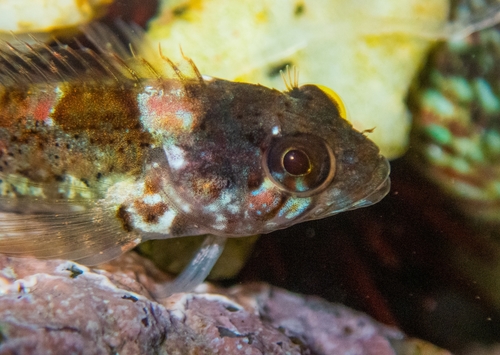
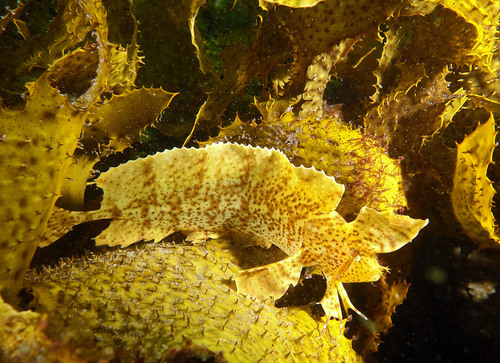
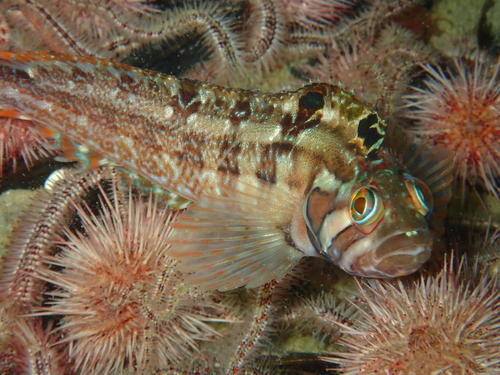
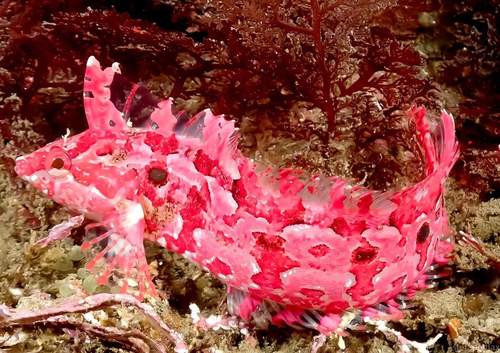
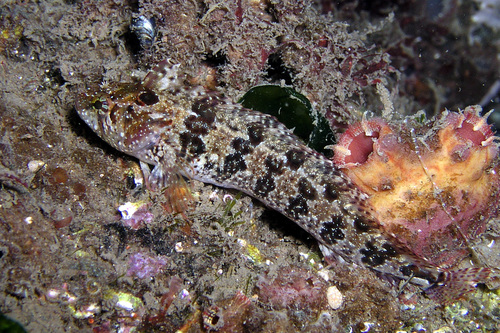
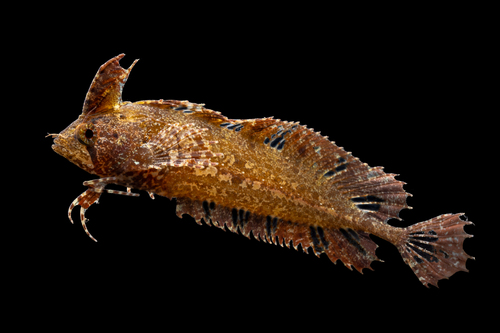
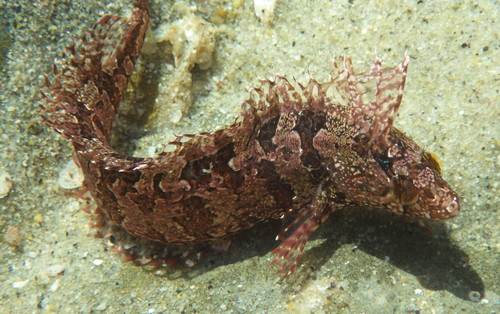
Gibbonsia elegans, commonly called the spotted kelpfish, is a relatively small fish with a slender, compressed, almost eel-like (anguilliform) body and a triangular head. Its maximum recorded body length is 120 mm. It is unknown if this species poses any toxic hazard to humans. It has a terminal mouth (meaning the mouth opens at the tip of the snout, angled neither upward nor downward), with conical sharp narrow teeth on both the upper and lower jaws, plus additional teeth in the center of the mouth’s roof. The spotted kelpfish has a fleshy flap of skin above its eye, and a smaller fleshy flap of skin in front of its eye. Individuals can have up to three distinct spots called ocelli on their body; most individuals have two ocelli: one above the pectoral fin and one further back on the body. The species’ dorsal fin runs the entire length of the body, starting at the level of the gill cover and ending at the start of the caudal fin. The anterior end of the dorsal fin usually has 3 to 5 spiny rays. The caudal fin is relatively small with a rounded tip. Like the dorsal fin, the anal fin is long, stretching from the caudal fin more than halfway up the fish’s abdomen. The fins of the spotted kelpfish are often semi-transparent. Gibbonsia elegans occurs in multiple color morphs, most commonly red, brown, or green. It has disruptive coloration similar to military camouflage: dark broken vertical bars over a one- or two-colored background. This patterning covers the entire body and extends onto the dorsal and pelvic fins. Male and female spotted kelpfish do not differ in overall color morphology, so they are not sexually dimorphic in general body color. Instead, they show sexual differences in body size and belly color. They have belly color dichromatism: females have yellow or tan bellies, while males and immature females have white bellies. Females also grow to longer lengths than males. The spotted kelpfish lives in shallow, rocky coastal waters from southern California including Baja, and requires aquatic vegetation in its habitat. It is sometimes found in calm bays, but is most common along open coastlines. Common plants found in its habitat include green surfgrass, brown algae, and red algae. It inhabits depths ranging from the lower intertidal zone (0 to 1.2 meters below mean sea level) to approximately 30 meters. As noted, the species has different color morphs that match the color of the vegetation in its habitat, and individuals can change their color over the course of several weeks. A 1988 study by Stepien et al. found that color changes in this species are determined only by the color of the surrounding habitat, not by the fish’s diet. Color change is also seasonal: the study found more red-colored Gibbonsia elegans in winter, when red algae are dominant, while green and brown morphs were more common in spring and summer. Male and female spotted kelpfish typically have different vertical depth distributions: females are more often found in shallow habitats, while males are more common at greater depths. A 1990 study by Holbrook et al. investigated how giant kelp distribution on reefs relates to the abundance of reef-dwelling fishes, and hypothesized that spotted kelpfish may be negatively affected by very high densities of giant kelp. This is because giant kelp outcompetes smaller understory algae, which the spotted kelpfish depends on. The study noted that other reef fishes requiring foliose understory algae would be harmed by the shading effect of dense giant kelp; the spotted kelpfish needs foliose understory algae through all its benthic life, planktonic larvae settle into understory algae, and older individuals remain there to hide from predators and feed on small invertebrates. Prior work by Carr (1989) found that spotted kelpfish populations were negatively impacted by giant kelp, through the reduction of understory algae. The authors suspected giant kelp would only affect the presence of species like spotted kelpfish when kelp forests are dense enough to completely eliminate all suitable understory algae. A 2020 study by Ginther and Steele examined the impacts of the invasive alga Sargassum horneri on temperate reef fish including the spotted kelpfish. The study concluded that reef fishes were barely or not at all impacted by the invasive alga, despite its widespread presence in many coastal areas. The authors noted that their field experiment, which completely removed S. horneri from 6×6 meter plots on natural reefs, provided strong evidence that fishes were not significantly affected by the invader, as there were no differences in fish density, species richness, diversity, or overall fish community structure between plots with and without S. horneri. For human use, the spotted kelpfish is considered economically insignificant to humans, except that it serves as food for certain game fishes. One source notes that it is occasionally caught by fishers using small hooks in rocky or kelp-covered areas of the California coast, but it is too small to be valuable as food.