About Geukensia demissa (Dillwyn, 1817)
Geukensia demissa is a species of mussel, a marine bivalve mollusk in the Mytilidae family, also known as the true mussels. This species is native to the Atlantic coast of North America. Its common names are ribbed mussel, Atlantic ribbed marsh mussel, and ribbed horsemussel. Note that the name ribbed mussel is also used for Aulacomya atra, a Southern Hemisphere mussel species.
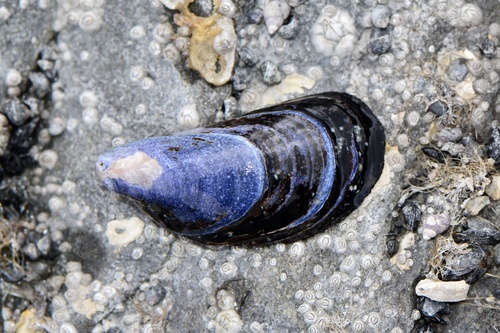
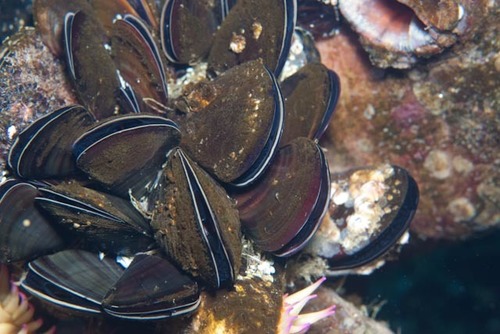
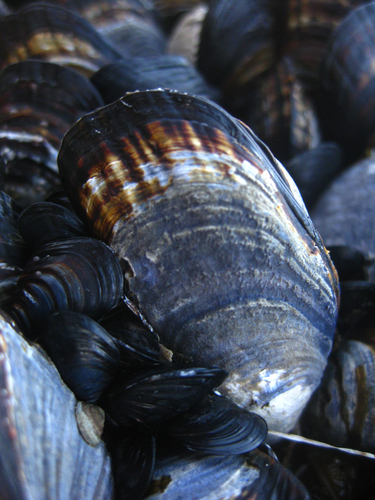
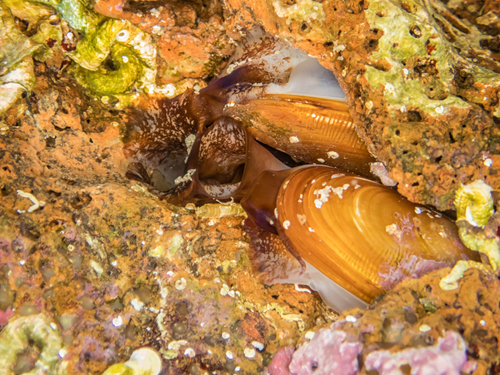
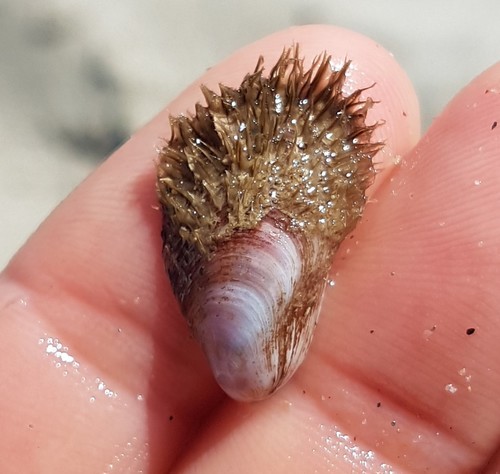
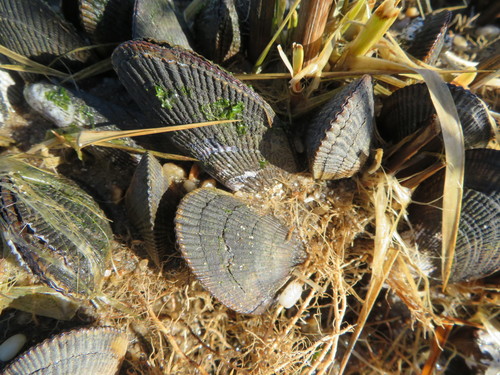
This mussel has a grooved, oval-shaped shell, and the interior of its shell is tinted purple. Adult ribbed mussels usually reach 10 cm in shell length, and can grow as large as 13 cm. The age of a ribbed mussel can be determined by counting dark growth rings on its shell. Individuals typically live 10 to 15 years, but older ages are not uncommon.
The ribbed mussel inhabits salt marsh coastal habitats ranging from the southern Gulf of St. Lawrence in eastern Canada, south along the western Atlantic coast to Florida. In the Gulf of Mexico, this species is replaced by the southern ribbed mussel Geukensia granosissima, and the two species hybridize in southern Florida. Ribbed mussels have been introduced to Texas, Mexico, California, and Venezuela.
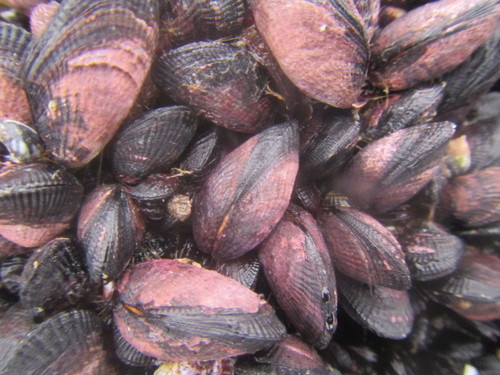
Ribbed mussels live in the intertidal zone, where they attach to hard surfaces or embed in sediment using byssal threads. They are most commonly found in salt marshes, where they form dense aggregations with each other and with marsh cordgrass (Spartina alterniflora); aggregating reduces an individual's chance of being preyed on. Ribbed mussels are highly sensitive to small temperature variations, so their specific placement within the salt marsh is critical, as temperatures vary widely across salt marsh habitats. Mussels located in dense Spartina patches tend to have warmer body temperatures than mussels outside these patches, and air flow also affects their body temperature. Their depth within sediment also impacts their internal body temperature.
Tidal height is another example of how microhabitat selection matters for this species. In higher tidal zones, ribbed mussels do not grow to their full potential, and fewer individuals occupy these areas; however, mussels in higher tidal zones tend to live longer and have a better survival rate. Ribbed mussels also experience higher predation rates along marsh edges. Known predators of ribbed mussels include birds, raccoons, and blue crabs.
Ribbed mussels are dioecious, and sex can only be determined through histological examination. Populations in Connecticut and South Carolina reproduce once per year, while an introduced population in Venezuela has been observed to have two spawning peaks per year. Most individuals larger than 15 mm are reproductively mature, but it is not uncommon for mussels up to 35 mm to show no signs of gametogenesis. Location within the salt marsh affects the timing of reproductive maturity: ribbed mussels living along marsh edges mature at smaller body sizes than conspecifics in other locations. During recruitment, ribbed mussel larvae return to the marsh, and tend to settle near marsh edges where adult ribbed mussels already live.
Humans have used this species historically: Native Americans near the Jamestown settlement produced shell beads called "rawrenock" in the local Powhatan language from ribbed mussel shells. The manufacturing process involved grinding broken ribbed mussel shells into disk-shaped beads, then drilling a central hole to string the beads into jewelry. Surviving examples of these beads have been recovered from refuse that filled an abandoned well within James Fort.