About Gerygone fusca (Gould, 1838)
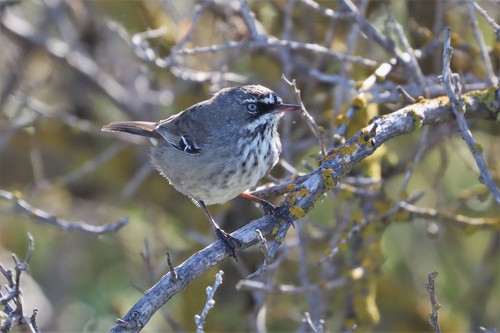
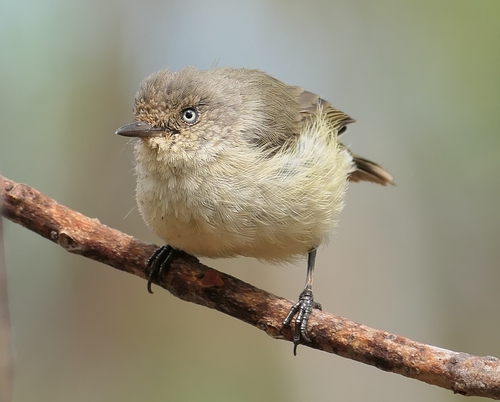
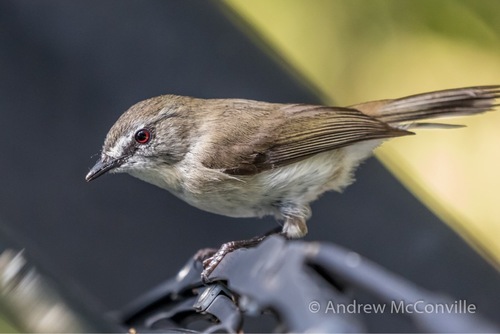
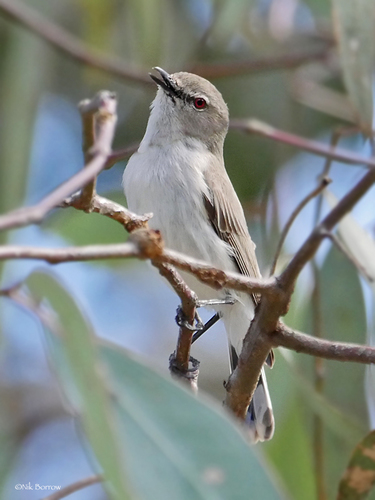
The western gerygone, scientific name Gerygone fusca (Gould, 1838), has plain brownish-grey upperparts with no prominent wing markings. Its underparts are whitish, with variable amounts of grey across the throat and breast. The species' outer tail-feathers have distinct markings: large white patches at the base, a broad blackish subterminal band, and white tips. Western gerygones are usually found alone or in pairs, foraging in the mid to upper storey of trees and shrubs, and they are often located by their characteristic persistent song. They can be very active while foraging. This species looks similar to several other Australian gerygone species, which do not usually share its habitat. Western gerygones can be distinguished from these similar species by the diagnostic large white patches at the base of their outer tail feathers. The western gerygone is endemic to Australia, and is the most widespread gerygone species. Its three subspecies have subtle plumage differences and form geographically separate populations. Subspecies fusca is found in south-west Western Australia. Subspecies exsul occurs in eastern Australia, ranging from the Carpentarian Basin through central and western Queensland, New South Wales, Victoria, and eastern South Australia; an isolated resident population on the Eyre Peninsula in South Australia is usually assigned to this subspecies. Subspecies mungi is found in central Australia, across the interior of Western Australia, the Northern Territory, and South Australia. Nomadic individuals may travel far outside the species' regular geographic range. Most Gerygone species are largely allopatric, and are usually separated from each other by geographic distribution or different habitat preferences. As the only gerygone of the Australian interior, the western gerygone does not overlap geographically with other gerygones across most of its range. There are two island populations of western gerygone, both located near Perth in Western Australia. Western gerygones colonized Rottnest Island in the 1950s, and were first observed on the island in 1955, before rapidly spreading into all suitable habitat. On nearby Garden Island, which lies closer to the Australian mainland, the species has been present since the start of European record-keeping. The western gerygone occupies a wide variety of wooded habitats, ranging from open sclerophyll forests dominated by many eucalyptus species, to sparse mallee and mulga shrublands. It is often found along watercourses, and in elevated regions it only occurs at elevations below 850 meters. Breeding most often takes place between September and January, though breeding has been recorded from August to March. Courtship consists of intricate chases between paired individuals. Pairs maintain territories throughout the breeding season, and territorial disputes involve agitated calls. Males display by intensely fluttering their wings and tail while holding their bodies tilted horizontally. The species builds a long, oval-shaped pendent nest, with a hooded entrance near the top and a 'tail' at the bottom. Both sexes participate in building the nest. Clutch size is usually 2 or 3 eggs, and rarely 4. Incubation lasts 10 to 12 days, and only the female incubates the eggs. The nestling period lasts 10 to 13 days, and both parents feed the nestlings. Parents continue to feed fledglings for up to 15 days after they leave the nest, until the fledglings reach independence.