About Gerres cinereus (Walbaum, 1792)
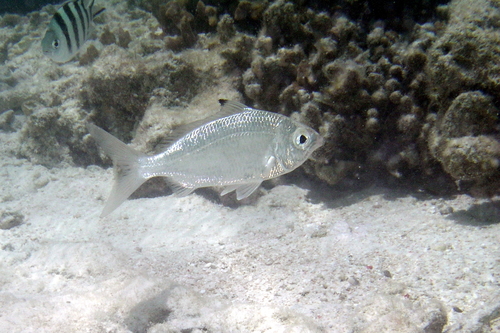
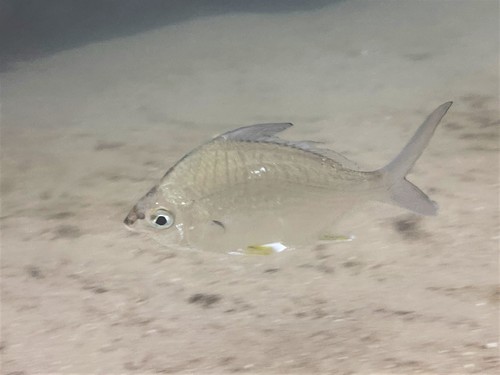
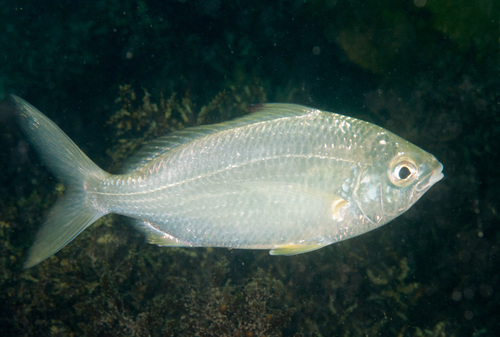
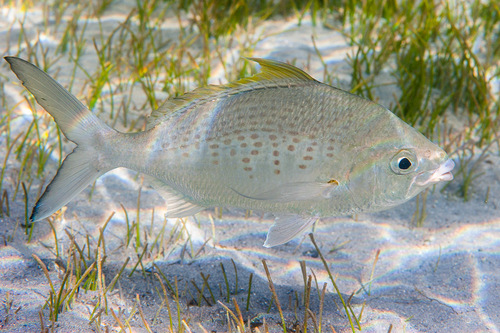
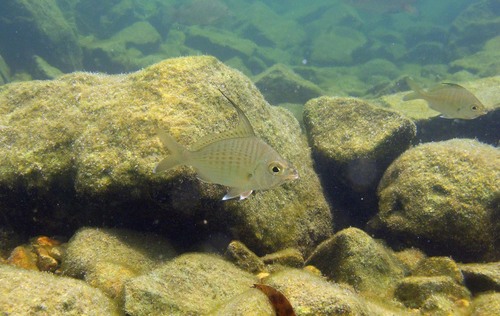
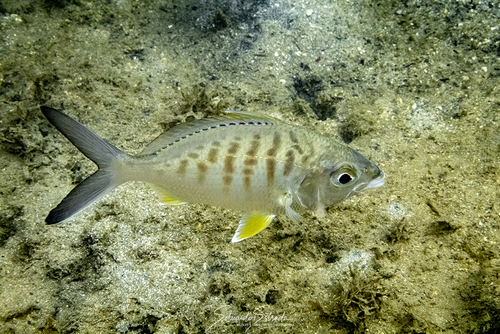
The fish Gerres cinereus, commonly called the Yellowfin mojarra, belongs to the widely distributed, diverse fish family Gerreidae, which contains over 50 nominal species. Species within this family are frequently confused with one another, but the Yellowfin mojarra has distinct morphological traits that set it apart. The Yellowfin mojarra has a compressed, slim body with a uniformly convex dorsal profile. Its jaws protrude slightly, and it has terminal mouth structures. Its body is a prominent solid silver, with no dark stripes across its scales, but it does have 6 to 8 vertical bars along its sides. The spinous dorsal, pelvic, and caudal fins are deep yellow or golden, while all other fins are darker. Most of its body is covered in thin, overlapping ctenoid scales that create its characteristic silver appearance. Its caudal fin is deeply forked and homocercal, and it has two long, continuous dorsal fins. The first dorsal fin is spiny, rigid, short, and curved. The second dorsal fin, composed of softer rays, extends all the way to the caudal fin and is slightly larger than the first. Juvenile Yellowfin mojarra typically have darker bars along their sides and light yellow tint on their fins. As they mature into adults, the side bars lighten and the yellow fin tint becomes more pronounced. Yellowfin mojarra are gonochoristic, and do not reach sexual maturity until two years of age. They breed year-round, with a breeding peak in August. The Yellowfin mojarra’s body morphology supports efficient function in its natural environment. Its slender, compressed body and forked tail improve swimming efficiency, allowing it to move quickly, which is advantageous for navigating the estuarine or shallow turbid coastal waters it occupies. Its slightly protruding terminal mouth is well-adapted for feeding. Its diet includes worms, clams, crustaceans, and other small fish, though plant detritus makes up an average of 74.9% of its total diet. The ability to protrude its mouth lets the fish push its snout into sand to capture buried invertebrates. Its terminal mouth shape allows it to hunt in both the lower to middle water column and the benthic zone. Thanks to this generalized diet, the Yellowfin mojarra is adapted to a wide range of environments. Its shiny silver body reflects light for mirror-like camouflage, which protects it from predators and also helps it stealthily approach prey. The fish’s single long dorsal fin helps it maintain stability in fast-moving waters, prevents rolling, and improves overall maneuverability. Yellowfin mojarra are distributed along the western coasts of North America and South America, with confirmed populations around the Gulf of Mexico, the Caribbean, Baja California, the Galapagos Islands, Peru, and Rio de Janeiro. They occupy tropical and subtropical coastal waters, though they have also been recorded in some freshwater environments. They most often roam shallow waters between 1 and 15 meters deep, and hunt and reside in habitats with sandy bottoms, coral reefs, mangrove zones, and seagrass beds. They thrive particularly well in shallow brackish waters that offer abundant prey and plenty of camouflage opportunities. Atlantic and Pacific populations of Yellowfin mojarra are the same species, but have non-overlapping ranges. While many other mojarra species do have overlapping ranges, which has made distinguishing between different species increasingly difficult as more have evolved.