About Geranium robertianum L.
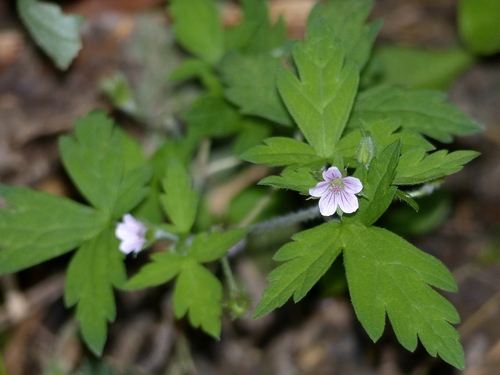
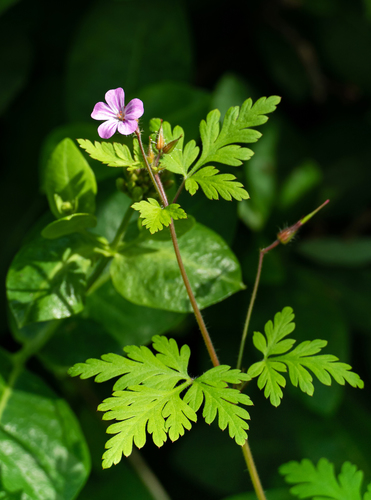
Herb-robert (Geranium robertianum L.) is a small herb that is most often biennial, but can sometimes be annual or short-lived perennial. It typically grows 30 cm (1 ft) tall and wide, occasionally reaching twice that size. Young plants form a basal rosette of leaves on 2-5 cm long petioles, with a very short vegetative stem. Older plants produce flowering stems from the axils of one or more basal leaves. Flowering stems may grow upright or sprawl along the ground, and some become stolons by rooting at their nodes. The entire plant is variably hairy, with a mix of long simple hairs and shorter gland-tipped hairs. When fresh plant material is bruised or uprooted, it gives off a strong, unpleasant odour, earning it the nickname "stinky Bob"; this odour fades over time. Plant colour ranges from all green, to reddish colouration at the nodes, stems or leaves, to bright red across the entire plant except the petals, which occurs most often when growing in full sun. Leaves are arranged alternately along stems, and are typically divided into three stalked lobes. The lower two lobes are further split, creating an overall five-lobed palmate shape. The largest lower leaves can reach around 11 cm in diameter. Leaflets are deeply lobed and toothed, with a short mucronate tip on each lobe. In northern Europe, flowering occurs from early spring to late autumn, and plants stay green through winter. Inflorescences grow on long peduncles that arise opposite a leaf on the flowering stem, and each inflorescence holds a pair of bisexual pink flowers 12-16 mm in diameter, borne on short 1 cm pedicels. Often one flower in the pair is abortive. The five sepals are around 5 mm long, lanceolate, and covered in both pink-tipped glandular hairs and eglandular hairs. Petals measure 8 to 14 mm long, are purplish-pink with white stripes, and have a basal claw slightly shorter than the petal limb. Unlike some other geraniums, the top of the petals does not have a notch. There are 10 stamens arranged in two rings of five, which project slightly beyond the flower, with purple anthers and yellow pollen; the inner ring of anthers matures and opens first. The female floral structure has five carpels connected to a single style, which splits into five pink stigmas at the top. The stigmas are already spread apart when the flower opens, which facilitates self-pollination, though cross-pollination also occurs. The fruit is a schizocarp that splits into five cylindrical 2.5 mm long mericarps when mature. Mericarps sit at the base of the style, and the basal column of the style elongates to about 1.5 cm as the fruit develops. A strip of tissue called an awn connects the tip of the style to each mericarp. When the fruit is ripe, the awn curls upward explosively from its base, ejecting the seeds roughly one metre away from the parent plant. Several similar-looking cranesbills can be confused with herb-robert. Shining cranesbill has lobed but undivided leaves, while long-stalked cranesbill has long points on its sepals. Herb-robert is very similar in appearance to little robin, but little robin has smaller flowers 5-9 mm in diameter, yellow anthers, and no odour. In Britain, distinguishing herb-robert from little robin is especially difficult in coastal locations, and multiple varieties and hybrids between the two have been described. Key distinguishing features for herb-robert are less pronounced ridges on ripe mericarps than little robin, petals twice as long as sepals (petals are only slightly longer than sepals in little robin), hairy leaves (little robin leaves are glabrous), and petals with white stripes (little robin petals are solid purple with no stripes). Herb-robert's main native range spans Europe, reaching north to the Baltic and east as far as Russia. It also occurs in North Africa, and is considered native to North America, though it is classified as a weed in some western North American states. It grows from sea level up to 700 m at Great Dun Fell in England, and up to 2,400 m in Kashmir. The IUCN has not assessed the global threat status of this species, but it is classified as Least Concern in some countries. In Britain, herb-robert has Ellenberg values of L=5, N=6, F=6, R=6 and S=0, meaning it typically grows in areas with light shade, moist neutral soils with moderate fertility, and no salinity. It can grow in a wide range of habitats, including full-sun shingle beaches and grikes in limestone pavements. Despite these average Ellenberg values, it is primarily a woodland plant and is tolerant of at least moderate shade. It is much more of a calcicole (lime-loving) than calcifuge (acid-loving), being most common in limestone and chalk woodlands and absent from many acid habitats. Its most common native vegetation communities in Britain include ash woodlands and hawthorn hedgerows. Across Europe, it occurs in 52 different habitats, and it is a diagnostic species for two habitats under the EUNIS habitat classification system: T1-F ravine forests and T1-G Italian alder carr. It is also considered characteristic of E5.43 shady forest edges, F3.11 Central European thickets on moist soils, H2.6C Illyrian sub-Mediterranean screes, and G1.7A1212 Pannonic alkali steppe oak woods. A re-evaluation of its ecological traits in Switzerland assigned it different Ellenberg values: L=3, N=4, F=3, R=6, T=3+ and K=3. The British database of insects and foodplants lists nine phytophagous (plant-eating) insect species that feed on herb-robert. Most feed on the leaves: the beetle Aphthona nigriceps, the meadow cranesbill weevil Zacladus geranii, the larvae of the weevil Limobius borealis, the bugs Dicyphus errans and Rhopalus subrufus, and the aphid Acyrthosiphon malvae. Of the remaining species, the beetle Byturus ochraceus eats pollen, the bloody cranesbill weevil Zacladus exiguus eats roots, and the larvae of the sawfly Ametastegia (Protoemphytus) carpini create leaf mines. Many more insect species are associated with herb-robert across Europe. White-flowered varieties of herb-robert have been cultivated in gardens for centuries. A small-flowered, fragrant white cultivar called 'Celtic White' is currently a popular garden plant. The origin of the common name herb-robert has several proposed explanations. Some link it to St Rupert (also known as Saint Robert), as the German common name for the plant is ruprechtskraut; an alternative German name translates to "stinking cranesbill". A connection to Saint Robert of Molesme has also been proposed. Another explanation suggests the name derives from Robin Goodfellow, a hobgoblin from northern European mythology. In Britain, the plant has dozens of regional common names, some such as "robin-in-the-hedge" and "robin's-flower" reference the European robin, due to the plant's reddish colour and hedgerow habitat. The medicinal value of herb-robert is uncertain. Influential herbalist Maud Grieve did not mention the species at all in her work, but folk medicine traditions in multiple countries use it to treat diarrhea, improve liver and gallbladder function, relieve toothache and stop nosebleeds, and as a vulnerary to heal wounds. Freshly picked leaves rubbed on the body are said to repel mosquitoes. Known chemical constituents of the plant include tannins, a bitter compound called geraniin, and essential oils. Some researchers have reported potentially useful medicinal properties in herb-robert extracts.