About Geranium purpureum Vill.
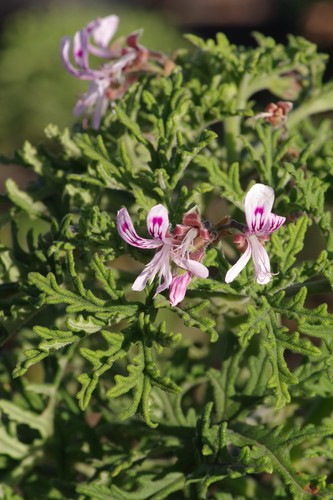
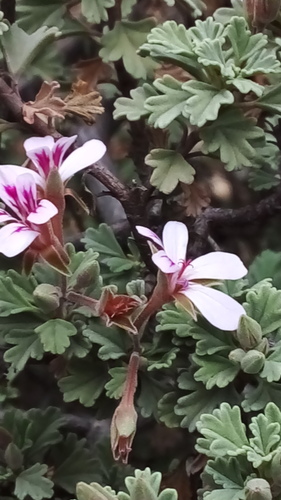
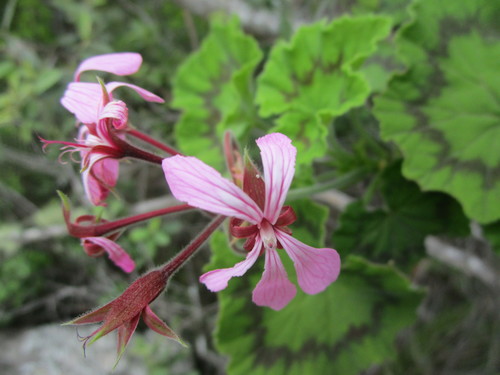
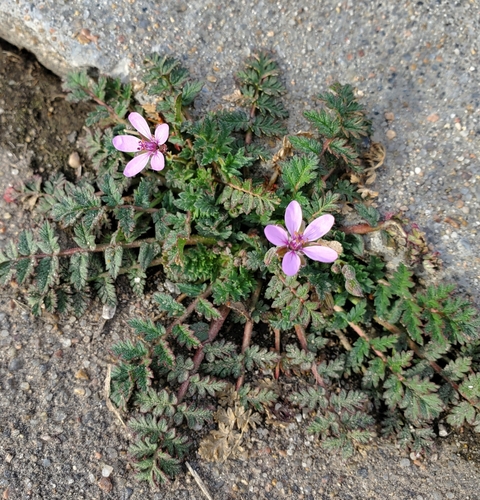
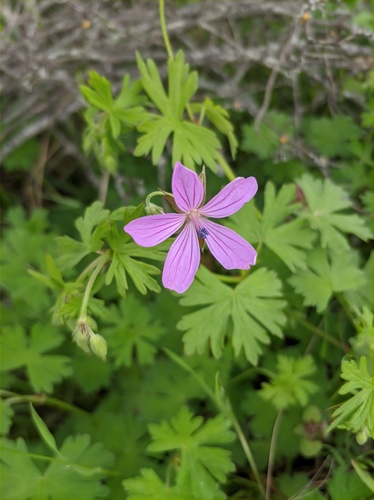
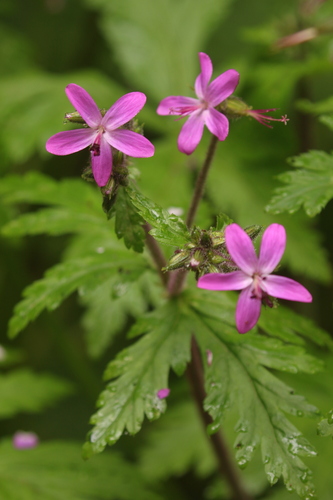
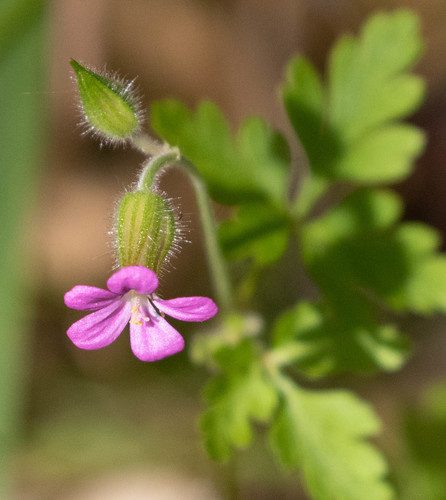
Geranium purpureum Vill. is an annual, or sometimes biennial, herbaceous flowering plant. It produces small flowers that have 5 sepals and 5 petals; each individual petal measures 6.3–8.4 mm long and 1.5–2.0 mm wide. Each flower holds 10 stamens, each bearing a yellow anther. At the center of the flower, one fused style supports 5 stigmas. Its fruit is a schizocarp, which splits into 5 one-seeded mericarps when it reaches maturity. This species is often confused with its close relative Geranium robertianum. The main feature that distinguishes the two species is flower size: the corolla of Geranium purpureum is approximately 7.5 mm in diameter, while the corolla of Geranium robertianum is at least twice that size, measuring 15–20 mm across. For comparison, a U.S. dime has an approximate diameter of 18 mm. An identification key for the genus Geranium in California separates the two species with the following traits: For Geranium purpureum, petals are (5.3–)6.3–8.4(–9.9) mm long and (0.8–)1.5–2.0(–2.6) mm wide, anthers are yellow, the middle leaf segment has 5–20(–38) lobes in its distal half, and the mericarp has 1–4 collar-like rings at its tip. For Geranium robertianum, petals are (8.5–)10.5–12.5(–14.2) mm long and (2.1–)2.6–4.5(–6.1) mm wide, anthers are purplish, the middle leaf segment has 16–37(–49) lobes in its distal half, and the mericarp has 1–2(–3) collar-like rings at its tip. Other identification keys highlight hairs on the sepals as an additional distinguishing characteristic. All keys include anther color as a distinguishing trait, but since both species produce yellow pollen, it can be hard to tell the two plants apart using anther color alone. Geranium purpureum has a chromosome number of 2n = 32, while Geranium robertianum has a chromosome number of 2n = 64. Native populations of Geranium purpureum range from Great Britain southeast to the Caucasus, and extend as far south as central Africa. Non-native populations are present on every continent except Antarctica. Introduced populations are most commonly found growing along railway corridors. This species cannot survive through winters where the average January temperature is 4 °C (39 °F) or lower.