About Geranium potentilloides L'Hér. ex DC.
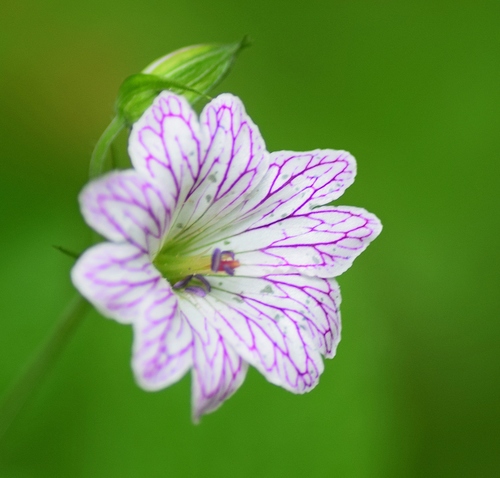
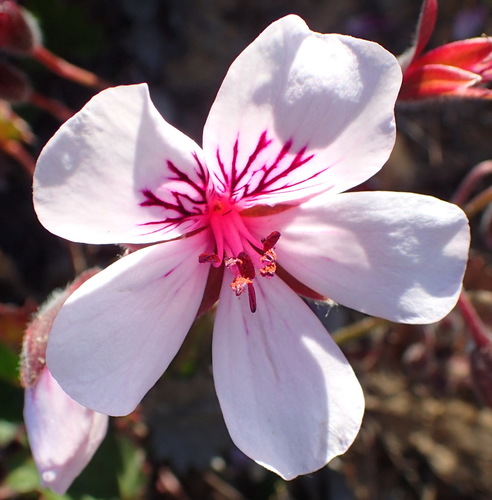
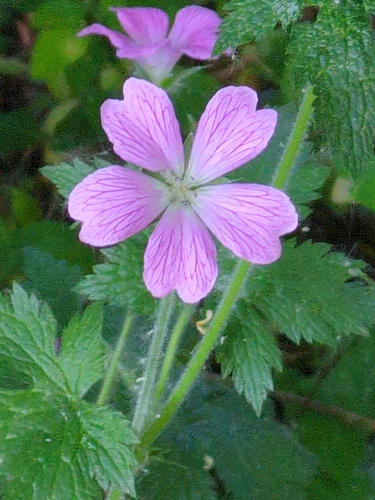
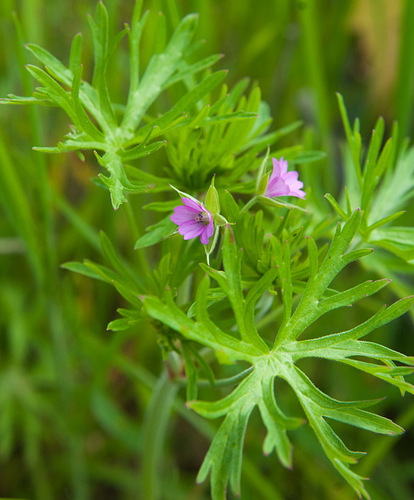
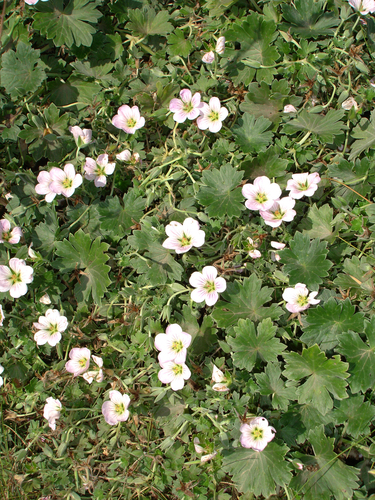
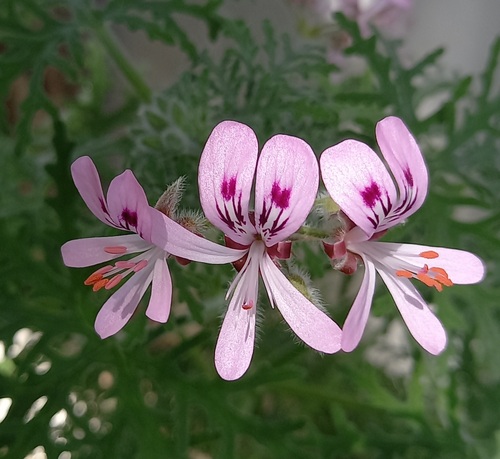
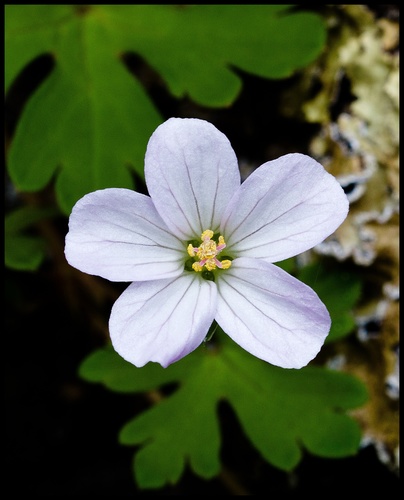
Geranium potentilloides L'Hér. ex DC. grows both upright and spreading, reaching 15 to 60 centimeters in height. It can root from its leaf nodes to form large, extensive clumps. Its leaves are dark green or greyish-green, with an indented, glossy surface; the underside of the leaves is often purplish. Leaves are round to kidney-shaped, divided into wedge-shaped segments, with 5 to 7 lobes per leaf. These lobes are narrow-obovate and toothed. Stem leaves are 1.5–3.5 cm long, up to 5 cm wide, and grow opposite one another on the stem. Basal leaves are larger than stem leaves and do not persist through summer. The stem has short, bristly reflexed hairs that are pressed toward the stem; these hairs also occur on the leaves. This species has a thick, multi-branched taproot system, and roots can form at nodes that come into contact with soil. Flowers are white to pale pink, borne singly on stalks up to 7 cm long. Each flower has five green sepals and five white to pale pink petals with translucent veins. Petals are 5-6mm long, with tips that may be notched or rounded. Each individual plant has both male and female organs, and is typically pollinated by insects. In its native habitat, Geranium potentilloides flowers from October to April. Its seeds are brown or black, and bear a bristle that helps the seed pierce soil crust to germinate. The fruit of this species is 12–14 mm long. Geranium potentilloides is native to southeastern Australia, New Zealand, and Indonesia. In Tasmania, Australia, it grows on eastern and central mountains up to 1000 m. It has also been introduced to coastal areas of central California, where it is called Australian cranesbill and flowers from May to August. It is commonly found in woodlands, grasslands, and moist forested areas, and prefers damp, shady sites. It requires well-drained moist soil, but can grow in drier basalt and clay soils, and dolerite in Tasmania. It can tolerate seasonal drought, but cannot survive prolonged inundation. The roots of Geranium potentilloides are edible raw or cooked. Aboriginal Australian people roasted the starchy roots for food, and they likely only ate the less bitter younger roots. Some Geranium species contain high levels of tannin, and were used as an anti-diarrhoeal treatment by aboriginal people.