About Geranium carolinianum L.
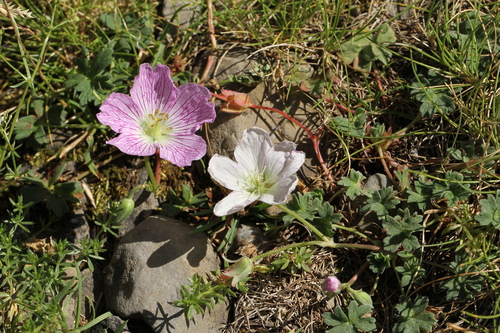
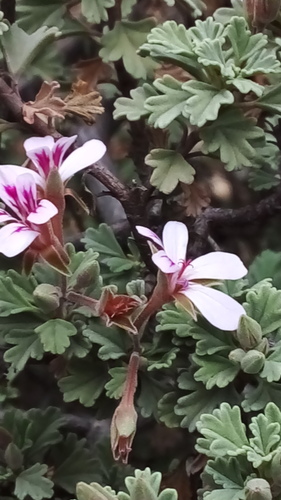
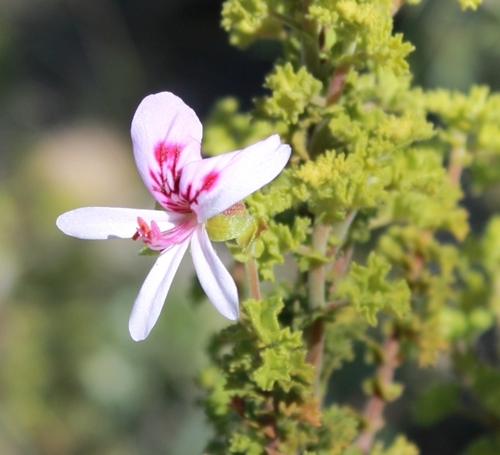
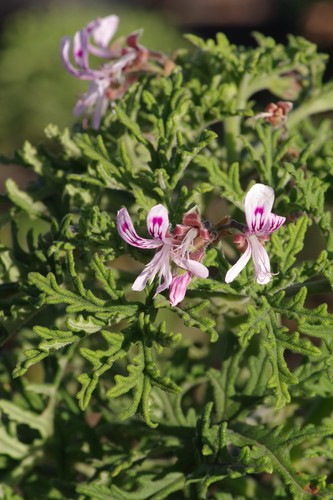
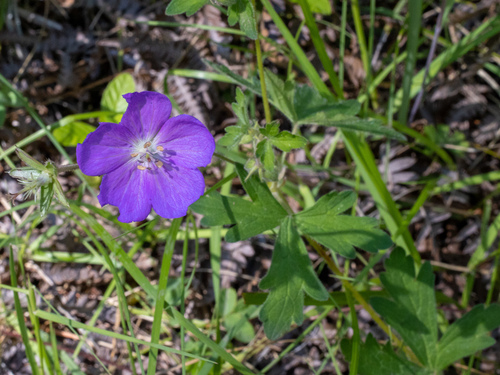
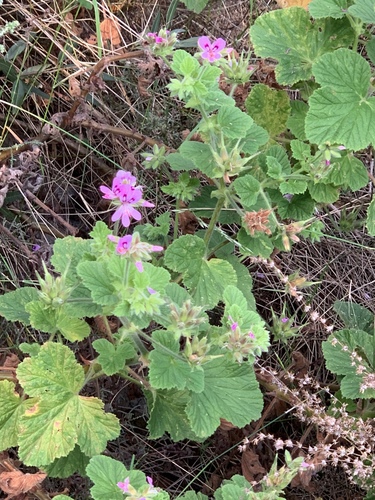
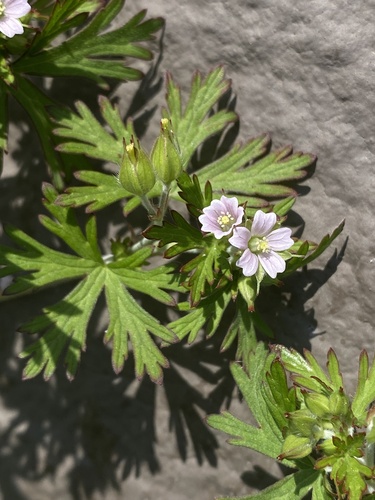
Geranium carolinianum L. has erect, pubescent (hairy) stems that are typically pink or red. Stems bear two leaves per node, arranged either alternately or oppositely. Stems are not succulent, and are not a calorie-rich food source for herbivores. The palm-shaped leaves are 3–8 cm wide. They are usually divided into five segments, each of which is further subdivided into elegantly pointed lobes and secondary lobes. Fine hairs on the leaf surface can give leaves a silvery or grey appearance; the underlying leaf color changes from green to deep red as the plant matures. The inflorescence is a cluster of 1 to several small flowers. Each flower has five pointed sepals that can be as long as the petals, and five notched petals in shades of white, light pink, or lavender. This petal trait helps distinguish G. carolinianum from other Geranium species. Flowers grow in short, tight clusters branching off the main stems. Anthers do not have nectar spurs. Carpels are hairy and fused together; there are five carpels and one pistil. Petals are rounded. Sepals are green to brown, ovate, thin, dry and paper-like, but flexible. The plant does not persist after flowering. Flowers bloom from late March through July. Flowers produce no strong scent to attract pollinators, and rely only on visual cues to draw insects to their sap. The fruit has a hairy body, and can reach 5 mm in length, with a style up to 1.5 cm long. Like other geranium species, the fruit has long beak-like structures, which gives the plant its common name of crane's-bill. Seed surfaces are finely reticulated; seeds have pits or depressions and are wingless. The fruit is dry and does not split open when ripe. The root system of Geranium carolinianum is a taproot that can grow 15 centimeters deep. The plant has a superior ovary. Geranium carolinianum is found across most of the continental United States, ranging from the New England region south to Central Mexico and along the Eastern coast. It grows best in dry, nutrient-poor areas with little competition, including clay and limestone prairies, lawns, roadsides, and abandoned fields and farmlands. It can survive in soils with pH levels too high for many other plants, as long as adequate water is available. Geranium carolinianum has potential as a treatment for hepatitis B. Ethanol extracts from the plant have also been found effective for treating inflammatory conditions. The anti-HBV compounds geraniin, ellagic acid, and hyperin present in G. carolinianum L. may explain why this folk medicine is effective for treating HBV infections. In cultivation, G. carolinianum prefers soils without excessive competition. It may be considered invasive in some regions, including Kentucky, New York, and Illinois, because it grows aggressively and can smother desirable plants. It is self-seeding and can survive transplanting to new locations for cultivation. Observed insect visitors that collect nectar include long-tongued bees (Megachile spp.), short-tongued halictid bees, and syrphid flower flies; syrphid larvae provide early cool-season aphid control. Northern bobwhites and mourning doves are known to eat the plant's seeds. It is a preferred winter forage for white-tailed deer in the Southeast, with an average of 19 percent crude protein when in its vegetative state.