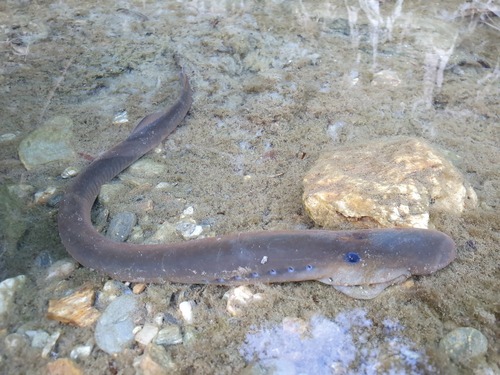
About Geotria australis Gray, 1851
Geotria australis, commonly called the pouched lamprey, shares key traits with other lampreys: it has a slender, eel-like body that reaches a maximum length of 60 cm (24 in), two low dorsal fins on the rear half of its body, and no jaws, only a suction-cup mouth. Freshly caught adult individuals from the sea have distinctly striking silver skin, which turns brown after they have spent time in fresh water; this color change is caused by the deposition of biliverdin. Adults have relatively small eyes positioned on the sides of the head. Once fully sexually mature, males develop a loose, baggy pouch under their eyes. This pouch has been hypothesized to help massage and oxygenate eggs; it has also been suggested that the equivalent pouch in Northern Hemisphere lamprey species is used by males to gather stones for nest building during the breeding season. The pouched lamprey is widespread across the Southern Hemisphere, found in New Zealand, Chile, Argentina, the Falkland Islands, South Georgia, and the southwest and southeast corners of Australia. It is the only lamprey species native to New Zealand. The dull brown freshwater ammocoete (larval) stage of the pouched lamprey stays this color for most of its life. Larvae remain in fresh water for approximately four years, then undergo a six-month metamorphosis, after which their body becomes silver with blue-green stripes. The central nervous system of the pouched lamprey undergoes significant development during metamorphosis into the large-eyed macropthalmia stage, with particularly large increases in the volume of the brain's visual areas. After this development, juveniles migrate downstream to the sea. Adult pouched lampreys spend part of their life cycle in the open sea, where they act as parasites on other fish. They attach to the gills or sides of host fish and rasp away at the tissue beneath the host's skin. Adults return to fresh water to breed, and spend up to eighteen months reaching sexual maturity before spawning. Adults have been recorded to live up to 105 days after spawning, and wrap themselves around egg masses to provide parental care.

