About Geothlypis trichas (Linnaeus, 1766)
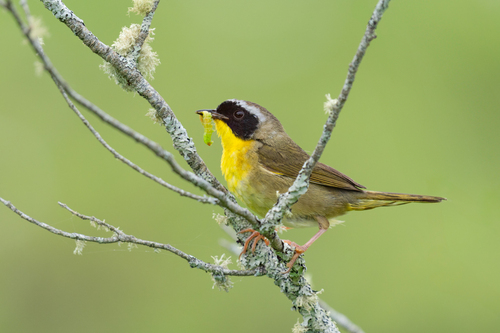
Common yellowthroats (scientific name Geothlypis trichas (Linnaeus, 1766)) are small songbirds. They have olive-colored backs, wings, and tails, yellow throats and chests, and white bellies. Adult males have a black face mask that stretches from the sides of the neck across the eyes and forehead, and this mask is bordered above by white or gray. Females have a similar overall appearance, but have paler underparts and do not have the black face mask. Immature birds look similar to adult females. First-year males have a faint black mask that becomes fully dark by spring. Subspecies of common yellowthroat differ mainly in the facial patterns of males and the brightness of their yellow underparts; southwestern subspecies are the brightest and most intensely yellow on their underparts. The species' song is a loud twichety twichety twichety twich, and its call is a soft jip. The species has the following measurements: length 11–13 cm (4.3–5.1 in), wingspan 15–19 cm (5.9–7.5 in), and weight 7.6–15.5 g (0.27–0.55 oz). Common yellowthroats breed in marshes and other wet areas with low, dense vegetation. They may also occur in other areas with dense shrubs, and are less commonly found in dry regions. Females of the species appear to prefer males with larger masks. Common yellowthroats build their nests in low vegetation; they lay 3–5 eggs in a cup-shaped nest, and both parents feed the hatched young. In terms of feeding behavior, common yellowthroats eat insects. They usually capture insects within dense vegetation, but will sometimes catch insects in midair. Nests of common yellowthroats are commonly affected by brood parasitism from the brown-headed cowbird (Molothrus ater).