About Geothlypis aequinoctialis (J.F.Gmelin, 1789)
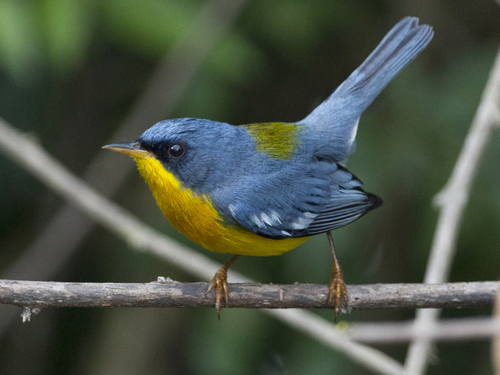
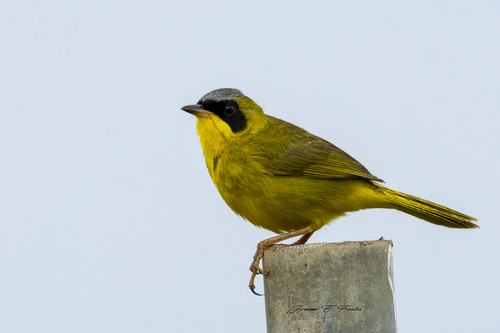
The masked yellowthroat, with the scientific name Geothlypis aequinoctialis, is a species of New World warbler. It has several separate resident breeding populations distributed across South America. Black-lored yellowthroat and southern yellowthroat were previously classified as subspecies of this bird. Its breeding habitat consists of marshes and other wet areas that have dense, low vegetation. It can also occur in other areas with dense shrub, but it is less common in drier types of habitat. This bird lays two white eggs marked with reddish-brown patterns; the eggs are placed in a lined cup nest positioned low down in grass or coarse vegetation. Adult masked yellowthroats measure 13.2 cm (5.2 in) in length and weigh 13 g (0.46 oz). They have yellow-green upperparts, bright yellow underparts, and a mostly black bill. Adult males have a black facemask, with a gray band bordering the mask along its upper edge. Females have a similar overall appearance, but they do not have the black mask. Females are also slightly duller in color, have variable amounts of gray on the head (often almost no gray at all), and feature a yellowish eye ring plus a yellowish stripe extending from the bill to the eye. Male plumage shows significant geographic racial variation, which is detailed in the species' taxonomic classification. This species can be easily told apart from wintering common yellowthroats: masked yellowthroats have uniform yellow underparts, while the North American common yellowthroat has a white belly. Masked yellowthroats are typically seen in pairs, and do not associate with other bird species. They often stay hidden in dense vegetation, but will occasionally come into view, especially to sing. They feed on insects including caterpillars, dragonflies, damselflies, grasshoppers, and beetles, as well as spiders. Most of their prey is captured within dense vegetation. Their vocalizations include a fast chattering call that is quite different from the calls of other yellowthroat species, plus a more typical sharp chip note.