About Geositta cunicularia (Vieillot, 1816)
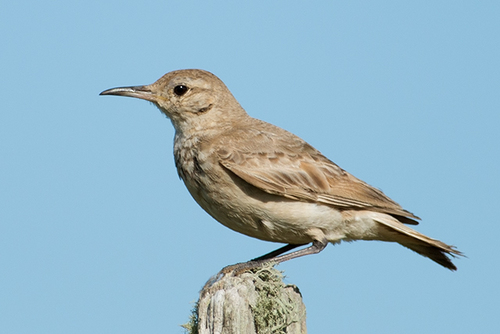
The common miner (Geositta cunicularia) is a medium-sized bird within its genus. It measures 14 to 17 cm (5.5 to 6.7 in) long and weighs 20 to 34 g (0.71 to 1.2 oz), and males and females have identical plumage. The nominate subspecies G. c. cunicularia has a pale brownish face marked with a wide whitish supercilium, a faint darker moustache stripe, and a faint darker line behind the eye. Its crown is dull grayish brown with dark brown spots, and its upperparts are also dull grayish brown. Its uppertail coverts are dull grayish brown with pale brownish tips. Its tail feathers have buff-whitish bases and blackish ends, with pale rufescent coloration between these two areas. The pale area on tail feathers grows progressively larger from the innermost to the outermost feathers, and the outermost feathers have almost entirely white outer webs. Dull brownish wing coverts with pale buff tips form distinct wing bars. Its flight feathers are dull brownish with a wide pale rufous band. The nominate subspecies has a whitish throat, a buff-white breast with wavy brownish streaks, a pale buffy whitish belly with a pale cinnamon tinge on the flanks, and whitish undertail coverts. Its iris is brown to yellowish brown, its medium-length bill is black to brown, sometimes with a pale base to the lower mandible, and its legs and feet are dark gray to black. Other subspecies differ from the nominate and from each other as follows: Geositta cunicularia titicacae is larger, paler, and buffier, with a creamier tail base and less distinct breast streaks; Geositta cunicularia juninensis is paler and buffier than titicacae, with few to no breast streaks; Geositta cunicularia frobeni has buffy white uppertail coverts, a whitish tail base, and whiter underparts than juninensis; Geositta cunicularia deserticolor is smaller and paler than frobeni, with gray uppertail coverts; Geositta cunicularia georgei is similar to deserticolor but has darker wings and tail, pale yellowish buff underparts, and heavier breast streaks; Geositta cunicularia fissirostris is slightly grayer on the upperparts and whiter on the underparts than the nominate, with darker chest markings; Geositta cunicularia hellmayri is similar to fissirostris but has whiter uppertail coverts, a paler tail base, and paler chest markings; Geositta cunicularia contrerasi is the smallest subspecies, with size overlapping hellmayri, it has the darkest blackish wings and tail of all subspecies, creamy buff underparts, and dark brownish or blackish spots on the breast. Subspecies of the common miner have the following distributions: Geositta cunicularia juninensis is found in the Andes of the central Peruvian departments of Junín and Huancavelica; Geositta cunicularia titicacae occurs in the Andes of southern Peru, Bolivia east to Cochabamba Department, northern Chile as far south as the Tarapacá Region, and northwestern Argentina as far south as Mendoza Province; Geositta cunicularia frobeni lives on the Pacific slope of the Andes in southern Peru between the departments of Arequipa and Tacna; Geositta cunicularia georgei inhabits coastal Peru's Ica and Arequipa departments; Geositta cunicularia deserticolor is found along the coast from Arequipa Department in Peru south to Chile's Atacama Region; Geositta cunicularia fissirostris occurs in central Chile from coastal Atacama to Los Lagos regions, and extends east to the Andean foothills; Geositta cunicularia contrerasi is restricted to Sierras Grandes in Argentina's Córdoba Province; Geositta cunicularia hellmayri lives in the Andes of central Chile and southwestern Argentina, south of the range of titicacae; Geositta cunicularia cunicularia is found in the lowlands of extreme southeastern Brazil, Uruguay, eastern Argentina, and southern Chile south to Tierra del Fuego. While the International Ornithological Committee includes Paraguay in the range of the nominate subspecies cunicularia, the South American Classification Committee of the American Ornithological Society has no recorded observations of the species from that country. The common miner inhabits open landscapes, including puna, temperate grasslands, arid lowland scrublands, and moister restinga scrublands. Most of its habitat is flat to gently sloping, with sandy soils, short grass, and scattered rocks and shrubs. The species' overall distribution tends to be patchy. It occurs across a wide elevation range, from sea level up to 5,000 m (16,000 ft).