About Geophilus flavus De Geer, 1778
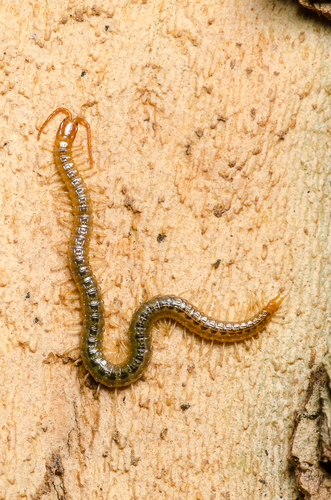
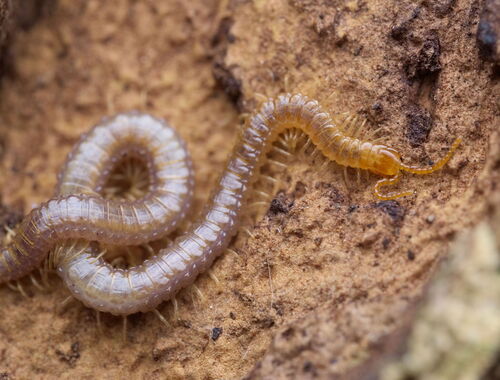
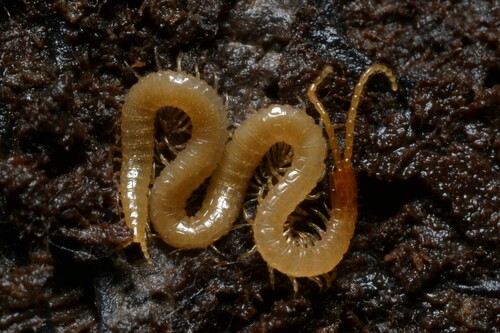
Geophilus flavus, described by De Geer in 1778, are yellow centipedes that can reach up to 45 millimetres (1.8 in) in length. They are completely sightless, so they rely on specialized sensory organs to detect movement, humidity, and light. Like all myriapods, they have an exoskeleton, plus a pair of antennae on both the head and rear. These antennae are used to locate prey and process both olfactory and tactile stimuli. Males of this species have 47 to 55 pairs of legs, while females have 49 to 59 leg pairs. The first pair of legs bears small pincer-like claws called forcipules, which hold poison ducts. These structures allow G. flavus to grab and immobilize prey before eating it. As an epimorphic species, young G. flavus can regenerate lost legs. This species is widely distributed across parts of Europe, North America, and Australia, in suitable habitats including grassy woodlands and forests. It can be found throughout most of the Palaearctic region, stretching from North-West Africa all the way to Siberia. It is common across the entire Baltic basin, and occurs in a range of tropical, coastal, and temperate habitats. G. flavus is particularly sensitive to relative humidity, because it loses water through its exoskeleton, spiracles, and cuticles. Because of this, the species is most abundant in microsites with high humidity and high rainfall. The presence of G. flavus in soil environments affects rates of bio-organic decomposition and shapes top-down prey relationships. It plays a key role in maintaining ecological stability in small-scale soil communities by regulating populations of smaller prey. G. flavus generally avoids light and shows a clear preference for moister habitats. It is a cryptozoic species, spending most of the daytime under stones and in leaf litter, and only emerges to hunt at night. Depending on the season, G. flavus burrows at different depths in soil. In wetter, more tropical conditions, the centipede burrows close to the soil surface, at around 7 cm deep. In drier weather, it burrows deeper, between 7 and 14 cm deep. G. flavus moves through soil in the same way as earthworms: it extends its body forward, then contracts to pull the rest of its body toward its head. This movement creates soil tunnels and burrows, which enable air and water to flow to underground plant roots. G. flavus populations in more temperate regions are generally perennial, living longer and having lower reproductive potential than tropical populations of the species. Like most arthropods, G. flavus reproduces sexually. Mating begins with a courting ritual, which involves a sequence of defensive postures, plus tapping of the legs and antennae on the partner's extremities. After courting, the male produces a web and deposits sperm for the female to collect. The species is typically solitary, except when mating or guarding eggs or hatchlings. Females lay clutches of 50 to 60 eggs in soil or rotten wood. They stand guard over the eggs until the young hatch, protecting their brood by positioning themselves in a sternum-upward posture. This position keeps the female's defensive glands away from the young, protecting vulnerable eggs from the glands' poisonous secretions. The mother cares for her brood for several weeks or months, until the young are developed enough to hunt independently. The average lifespan of this centipede ranges from 2 to 6 years, depending on habitat and seasonal conditions.