About Geopelia striata (Linnaeus, 1766)
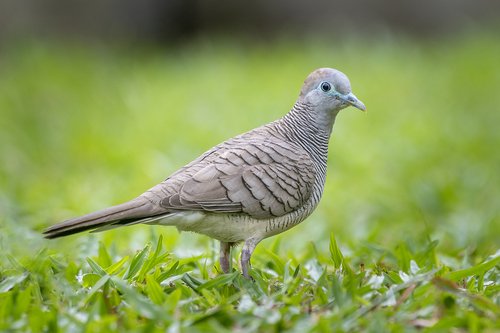
This species, scientifically named Geopelia striata (Linnaeus, 1766), is commonly known as the zebra dove. Zebra doves are small, slender birds with a long, narrow tail. Their upperparts are brownish-grey marked with black-and-white barring, while their underparts are pinkish, with black bars on the sides of the neck, breast, and belly. The face is blue-grey, with bare blue skin surrounding the eyes. The tips of the tail feathers are white. Juvenile zebra doves are duller and paler than adult birds, and may also have brown feathers. Adult zebra doves measure 20–23 centimetres in total length, with a wingspan of 24–26 centimetres. Their call is a sequence of soft, staccato cooing notes. In Thailand and Indonesia, these birds are popular as pets for their attractive calls, and cooing competitions are held to select the bird with the best voice. This species has different common names across regions: it is called perkutut in Indonesia; in the Philippines it is known as batobatong katigbe (meaning "pebbled katigbe") and kurokutok, an onomatopoeic name referencing its call; it is also called tukmo in Filipino, a name that is also used for the spotted dove (Spilopelia chinensis) and other wild doves; in Malaysia it is called merbuk. The native range of Geopelia striata stretches from Southern Thailand, Tenasserim, Peninsular Malaysia, and Singapore to the Indonesian islands of Sumatra and Java. It may also be native to Borneo, Bali, Lombok, Sumbawa, and the Philippine islands. Because the zebra dove is popular in captivity, many new populations have established outside its native range from escaped or intentionally released birds. Today it can also be found in central Thailand, Laos, Borneo, Sulawesi, Hawaii (introduced in 1922), Tahiti (introduced in 1950), New Caledonia, the Seychelles, the Chagos Archipelago (introduced in 1960), Mauritius (present before 1768), Réunion, and Saint Helena. It lives in scrub, farmland, and open lowland country, and is commonly seen in parks and gardens. Trapping to supply the cagebird trade has made this species rare in parts of Indonesia, but it remains common across most of its range. In some introduced locations such as Hawaii and the Seychelles, zebra doves are among the most abundant bird species.