About Geopelia humeralis (Temminck, 1821)
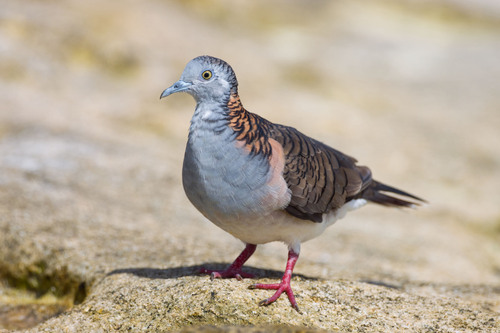
This species, Geopelia humeralis, commonly known as the bar-shouldered dove, has a blue-grey breast and chequered brown-bronze wings. Its copper-colored nape feathers are striated, a trait it shares with the peaceful dove. Unlike the peaceful dove, however, the bar-shouldered dove does not have striated throat feathers. It is often confused with the introduced common spotted turtle dove. The bar-shouldered dove's eye ring is typically grey, but turns red-brown during the breeding season. Juvenile birds have duller overall coloration than adults. Bar-shouldered doves are most often seen in pairs, small groups, or large loose flocks. They commonly feed on the ground, where their diet consists of seeds. Their flight is direct and swift, and their wings produce a whistling sound while they are in flight. Bar-shouldered doves typically inhabit areas of thick vegetation near water, including damp gullies, forests, gorges, mangroves, plantations, swamps, eucalyptus woodlands, tropical and sub-tropical scrubs, and river margins. They occur in both inland and coastal regions. Their range extends along Australia's east coast from southern New South Wales, where populations are growing in the Blue Mountains and Illawarra regions, north to Cape York Peninsula, and west to the Pilbara region around Onslow, Western Australia. They have been spotted with increasing frequency in southern Australia, specifically north-western Victoria, but may have been displaced from some natural locations by introduced species. Bar-shouldered doves have also been observed in the Torres Strait, and occur in other South Pacific countries including Papua New Guinea.