About Geomys bursarius (Shaw, 1800)
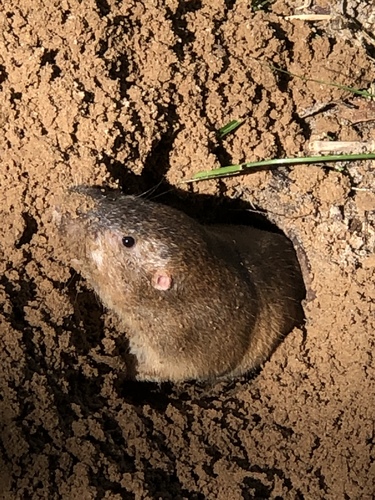
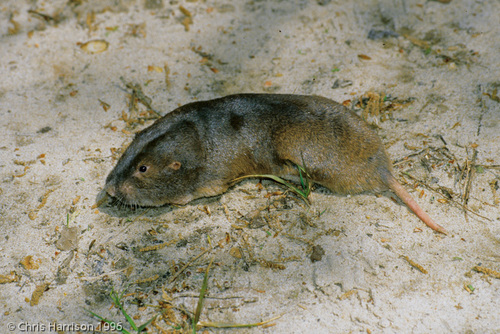
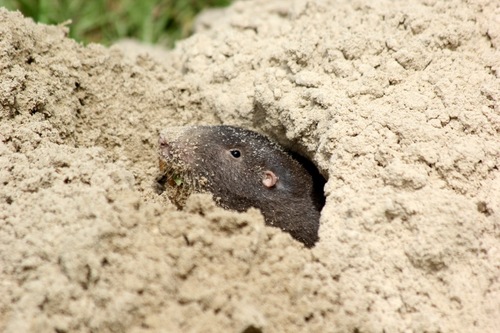
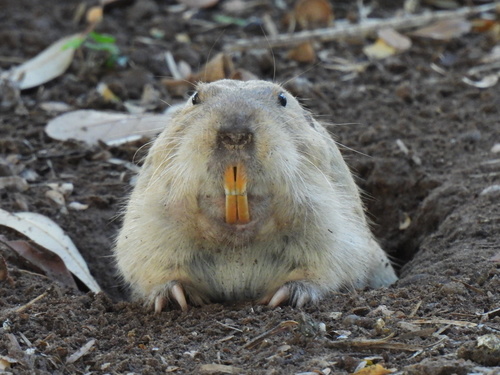
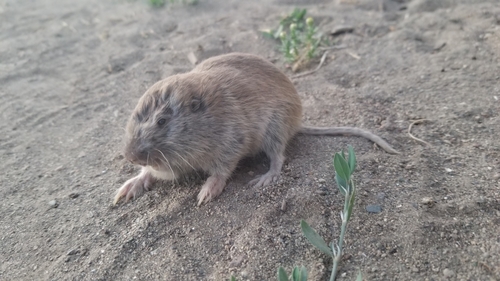
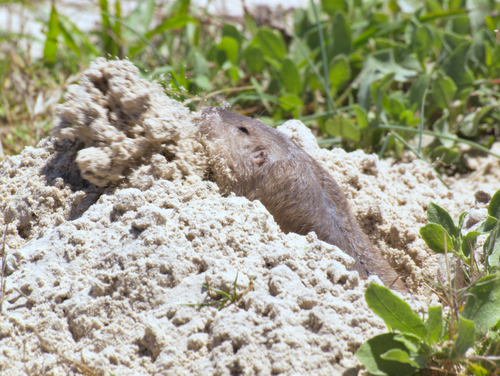
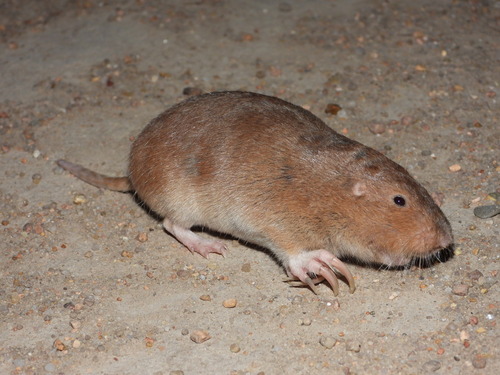
Geomys bursarius, the plains pocket gopher, has short fur: its upper body ranges from brown to black, while its underparts are lighter brown or tan. The tops of its feet are covered in whitish hairs, and its short, tapered tail is nearly hairless. As a fossorial (burrowing) species, it has several key adaptations: small eyes, short hairless ears, large front feet with thick claws, and widely flared zygomatic arches that provide plenty of space for muscle attachment. Unlike other pocket gophers, this species does not use its curved incisors to help its feet dig. The external cheek pouches that set the pocket gopher family apart from other mammals can be turned inside-out for grooming, open forward, and can carry food items up to 7 cm (2.8 in) long. Additional fossorial adaptations include a low resting metabolic rate of 0.946 ml O2/g/h, high conductance, tolerance for low oxygen and high carbon dioxide levels, and reduced water intake. Males are noticeably larger than females. Total body length is 25 to 35 cm (9.8 to 13.8 in) for males, and 21 to 32 cm (8.3 to 12.6 in) for females. The short, hairless tail is 5 to 11 cm (2.0 to 4.3 in) long, and is only slightly longer in males than in females. Adult males weigh 230 to 473 g (8.1 to 16.7 oz), while adult females weigh 128 to 380 g (4.5 to 13.4 oz). Plains pocket gophers are found across the Great Plains of North America, ranging from southern Manitoba in Canada and eastern North Dakota in the United States, south to New Mexico and Texas, and east to the extreme western part of Indiana. Eight subspecies are currently recognized; some previously classified subspecies are now considered full species and are no longer included. The recognized subspecies are: Geomys bursarius bursarius, found in Canada, the Dakotas, and Minnesota; Geomys bursarius illinoensis, found in Illinois; Geomys bursarius industrius, found in southwestern Kansas; Geomys bursarius major, found in Texas, Oklahoma, and eastern New Mexico; Geomys bursarius majusculus, found in Iowa, eastern Nebraska and Kansas, and northern Missouri; Geomys bursarius missouriensis, found in eastern Missouri; Geomys bursarius ozarkensis, found in Arkansas; and Geomys bursarius wisconsinensis, found in western Wisconsin. Fossil remains of the species have been found as far south as Tennessee, indicating a population existed there during the late Pleistocene and early Holocene. This finding supports the hypothesis that drier environments with extensive prairies extended further south during the Late Wisconsinan glacial period, supporting populations of Geomys and other prairie species including thirteen-lined ground squirrels and prairie chickens. Plains pocket gophers prefer deep, sandy, friable soils to support their burrowing lifestyle and herbivorous diet of plant roots. Soil texture is more important than local vegetation for habitat selection, and the gophers can be found in prairie grasslands, agricultural land, and even urban areas. A long-term controlled study of tunnel digging by plains pocket gophers found the rate of new tunnel construction ranges from a high of 2,059 cm of new tunnels per week to no new tunnel construction over multiple weeks in summer. At any given time, around 30 to 50 m (98 to 164 ft) of tunnel is kept open. Tunnel system size is more strongly influenced by the energy required to maintain and patrol the system than by the amount of available vegetation. Tunnel systems include nests located around 50 cm (20 in) underground, lined with grass and other plant material, plus food caches that store grasses, roots, and tubers. Multiple insect species, including flies, scarab beetles, carrion beetles, and cave crickets, share the gophers' tunnels. Known predators of plains pocket gophers include rattlesnakes, prairie kingsnakes, gopher snakes, feral cats, coyotes, foxes, badgers, hawks, and owls. Plains pocket gophers typically breed only once per year, though they may breed twice in years with good conditions or in warmer climates. The breeding season changes with latitude: it runs from April to May in Wisconsin, and can last from January to September in Texas. After a gestation period of around 30 days, females give birth to one to six young. Pregnancies as long as 51 days have been recorded; this variation may indicate delayed fertilization, delayed implantation, or delayed zygote development. Newborn plains pocket gophers are born hairless and blind, and initially weigh around 5 g (0.18 oz). They start growing fur at 10 days old, open their eyes at three weeks, and are weaned by five weeks old. While young gophers move around their mother's burrow at first, they leave quickly after weaning to dig their own burrows, and reach full adult size around three months after birth.