About Geomalacus maculosus Allman, 1843
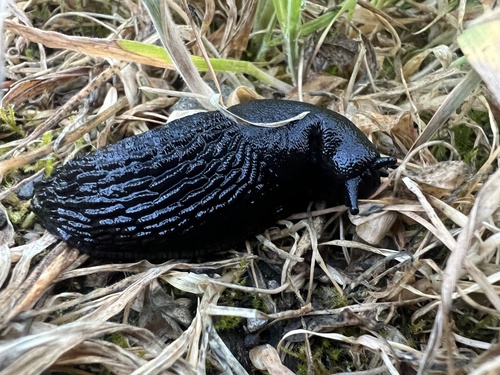
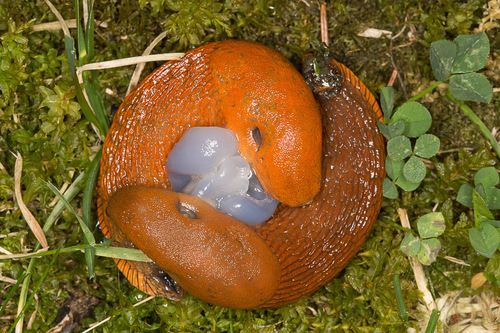
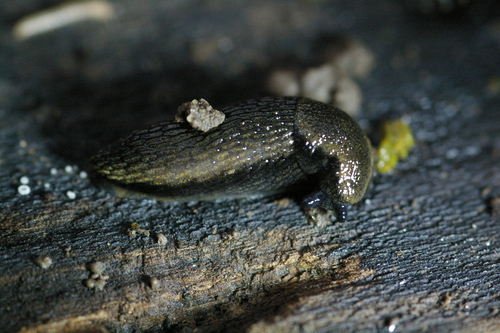
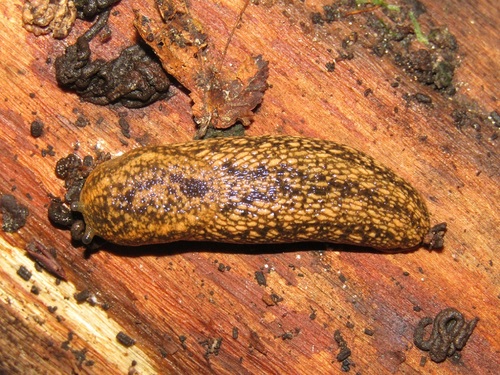
This species, commonly known as the Kerry slug, has the scientific name Geomalacus maculosus Allman, 1843. Adult Kerry slugs normally measure 7–8 cm (2.8–3.1 in) in body length, but accurate measurement is difficult due to their unusual startle response. They can elongate themselves inside crevices to reach up to 12 cm (4.7 in). Official measurements for the species vary; Kerney et al. (1983) recorded a measurement range of 6–9 cm (2.4–3.5 in). One fixed preserved adult specimen measured 7 cm (2.8 in) in body length, with a mantle 3 cm (1.2 in) long. The Kerry slug has a glossy body, with around 25 longitudinal rows of polygonal granulations covering both sides. It has two distinct color morphs: brown and black. In Ireland, the black morph lives in open habitats while the brown morph lives in woodland, a pattern that matches surrounding colors and suggests camouflage. Experiments confirm that dark coloration develops in response to light exposure during the slug's growth. Banding patterns also vary: each side of the body may have two bands, one just below the ridge of the back and the other lower down the side. When present, these bands usually extend the full length of the body, and are covered by numerous ovoid yellow spots arranged roughly in five longitudinal zones. Behind the slug's head is the shield-shaped outer surface of the mantle. When the slug is actively crawling and extended, the mantle is roughly one third of the body's total length; when the slug is stationary and contracted, the shield makes up around half the body length. The front of the shield is rounded, and its rear end is bluntly pointed. The texture of the mantle resembles the underside of undyed leather, and it is marked with pale, buff or light-colored spots that are similar to the spots on the body but more evenly distributed. The foot fringe, a band of tissue along the edge of the foot, is not distinctly separated, is very pale, somewhat expanded, and marked with faint, indistinct lines. The sole of the foot is pale grey-yellow, and divided into three faint bands; the central band is slightly darker and more transparent than the two side bands. A caudal mucous pit sits between the foot and the body on the upper surface of the tail tip. This pit, which collects excess mucus, is inconspicuous, triangular, and opens transversely. It often holds a transparent, yellowish ball of mucus. The Kerry slug's upper tentacles are smoky-black or grey, short and thick with oval tips, and bear eye spots at their ends. The genital pore sits behind and below the right eye tentacle. The lower tentacles are pale grey and translucent. The Kerry slug's skin mucus is typically pale yellow with variable viscosity. Its locomotory mucus is tenacious and usually colorless, but sometimes turns yellow from mixing with skin mucus. The Kerry slug has a disjunct discontinuous distribution: it is only found in Ireland (mostly in the southwestern corner), northwestern Spain, and central to northern Portugal. It was once reported to occur in France, but this record has never been confirmed and is considered unreliable. This specific pattern of disjunct distribution across Iberia and Ireland with no intervening populations is called a "Lusitanian distribution", a pattern also seen in other plant and animal species. There is speculation that G. maculosus was introduced to Ireland from Iberia by prehistoric humans, a similar introduction is thought to have occurred for the Eurasian pygmy shrew. This theory of introduction, whether prehistoric or more recent human-mediated, is supported by the finding that genetic diversity of Kerry slugs in Ireland is greatly reduced compared to Iberian populations of the species. It was once believed that Geomalacus maculosus only lives in wild habitats. In the Iberian Peninsula, it can be found on tree trunks in oak (Quercus) and chestnut (Castanea) forests, but it is easiest to locate in synanthropic habitats including rocky walls in oak or chestnut orchards, ruins, and areas near houses, churches and cemeteries. In Ireland, it also lives in upland conifer plantations and clear-felled areas. Unlike some other slugs in the family Arionidae, the Kerry slug is not considered an agricultural pest. In Ireland, the Kerry slug inhabits oak woodland, oligotrophic open moorland, blanket bogs and lake shores, particularly in habitats with boulders covered in lichens and mosses. While it was once geographically associated with sandstone areas, a newly recorded locality in Galway is on granite. In Iberia, it typically inhabits granite mountains, and also occurs on areas with slate, quartzite, schist, gneiss and serpentine. The best predictors of its presence are high rainfall and high summer temperatures. Kerry slugs mate in a head-to-head position, with each partner's genital opening facing the other. After mating, their funnel-shaped sexual organs called atria (singular: atrium) have fluted edges. Like slugs of the genus Arion, Kerry slugs transfer sperm inside a spermatophore. In the wild, egg laying takes place between July and October; in captivity, egg laying can occur from February to October. This species is also capable of self-fertilization. Eggs are laid in clusters of 18 to 30, held together by a thin film of mucus. An entire egg mass measures approximately 3.5 cm × 2 cm (1.38 × 0.79 in). The eggs are very large relative to the size of the adult slug. The largest eggs are more elongated, measuring 8.5 mm × 4.25 mm (0.335 × 0.167 in); the smallest are more ovoid, measuring 6 mm × 3 mm (0.24 × 0.12 in). All fresh eggs are semi-translucent, milky-white or opalescent, though some larger elongated eggs have a semi-translucent area at their smaller end. The opalescent sheen fades within a few days, and the eggs turn yellowish, then later brown or black. Young slugs hatch after six to eight weeks. When newly hatched, the body spots are barely visible, but the lateral bands are distinct and black, and are more noticeable than in mature slugs of this species. Juveniles have lyre-shaped markings on the shield, just like slugs of the genus Arion. These lyre-shaped markings fade as the slugs grow larger. Kerry slugs likely overwinter while still sexually immature. Preserved juvenile specimens have bodies up to 3 cm (1.2 in) long, with a mantle length of 10 mm (0.39 in). Juveniles reach maturity after two years, at a body length of around 2.6 cm (1.0 in). In the wild, the Kerry slug can live up to seven years, but in captivity its lifespan rarely exceeds three years. In many localities across Spain, very few individuals of the species have been observed at any single time. Before 2014, no natural enemies of Geomalacus maculosus were known. The only confirmed natural predator of the Kerry slug is the third instar larva of the fly Tetanocera elata.