About Geomalacus anguiformis (Morelet, 1845)
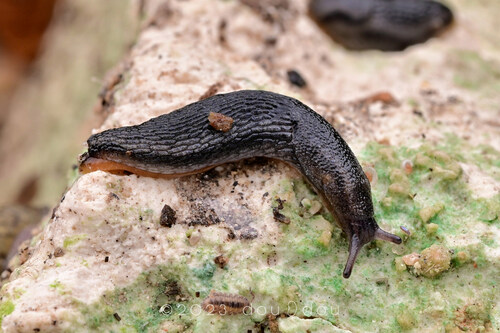
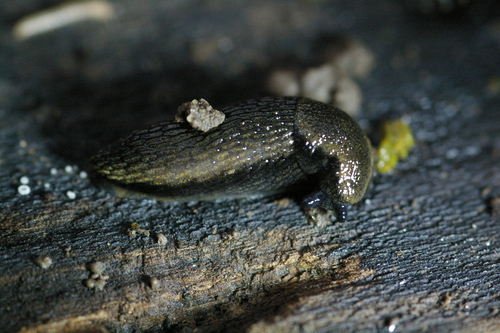
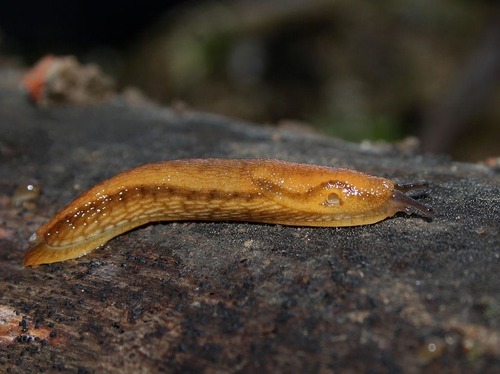
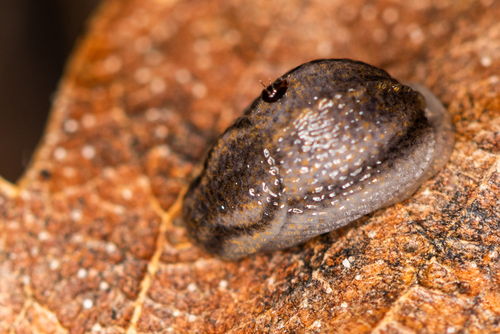
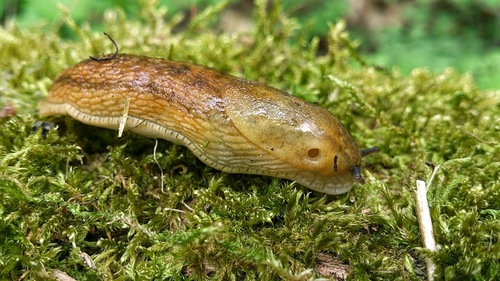
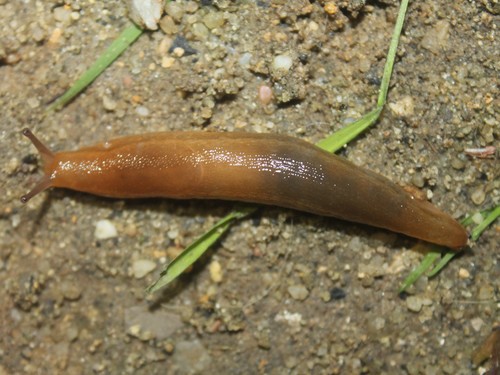
This species has the scientific name Geomalacus anguiformis (Morelet, 1845). The slug is dark grey with a brown tint, and its sides are lighter. Two light-colored bands with dark lower margins run along both sides of its elliptical mantle, which extends to the tentacles on its anterior end. Its tentacles are thick, not very long, and nearly black. When crawling, the slug does not always hold a regular cylindrical shape, and may have depressions and dilatations along its body. Its sole is light creamy with a darker medial zone, and has a yellowish or greenish tint. Its mucus is yellow. Adults of this species reach 60 mm in length; preserved specimens measure 30 mm. The species has an elliptical, solid shell, with a convex upper side and a flat lower side. The reproductive system is the diagnostic feature for identifying this species: Geomalacus anguiformis has an atrial diverticulum shorter than the spermatheca duct, while the related Kerry slug Geomalacus maculosus has an atrial diverticulum longer than the spermatheca duct. Geomalacus anguiformis has a long penis, a very thin vas deferens, and an oval spermatheca with a long duct. It differs from Geomalacus oliveirae because its atriopenis inserts at the prolongation of the atrial long axis, rather than inserting laterally. This species occurs in south Portugal (Serra de Monchique) and central Spain. Individuals of Geomalacus anguiformis have been found in olive plantations, under bark.