About Geograpsus lividus (H.Milne Edwards, 1837)
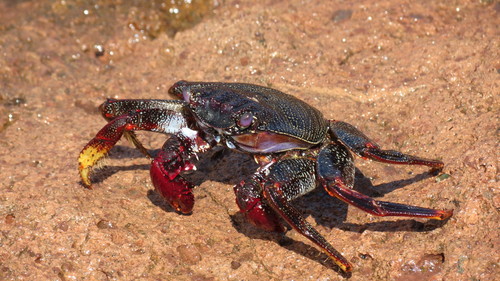
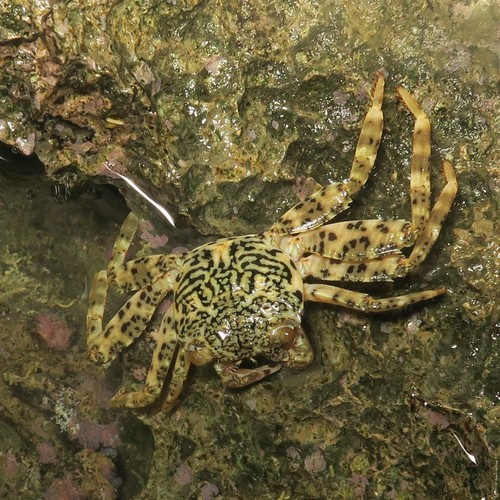
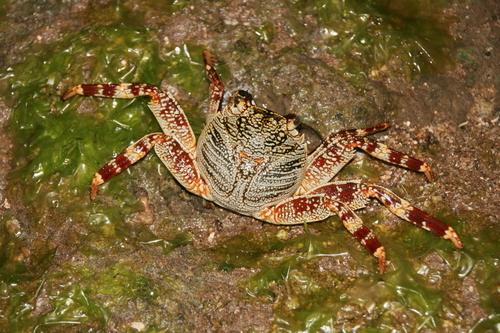
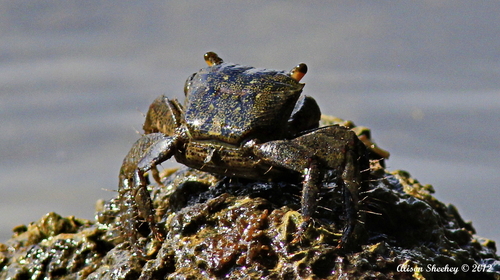
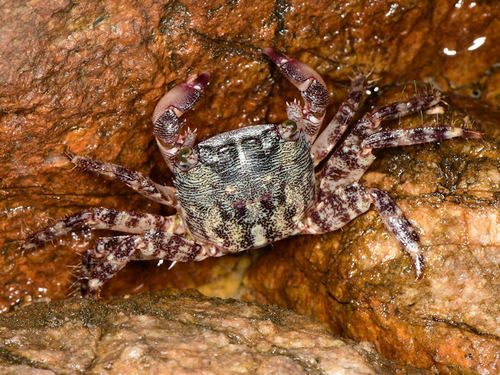
Megaopae of Geograpsus lividus can reach a carapace width of about 25–35 mm (0.98–1.38 in). They are yellowish red in color, with distinct hairs on their legs. Their cephalothorax is globose, smooth, and lacks tubercles. Tubercles on the chela (claw) are only found on the upper half of the pincer at the end of the claw. Morphology differs between G. lividus populations from different habitats, most notably between Atlantic and Pacific populations. Atlantic zoeae of G. lividus have more outer minute spines on the furcal arms of the telson, and more aesthetase setae (bristles) on the antennule. There are eight recognized developmental zoeal stages for G. lividus, which take place over at least 60 days. This makes it the longest-recorded developmental pathway of any crab. Before entering the post-larval megalopae stage, the larvae grow exponentially, reaching up to 7200% of their initial biomass. This is also one of the fastest observed growth rates in the infraorder Brachyura. The largest larvae are found in the Gulf of Mexico, while the smallest are found in Jamaica. The ratio of sternum width to posterolateral margin width is larger in males than in females. Geograpsus lividus is native to east Africa, the Cook Islands, Hawaii, and the western Atlantic. It is currently present throughout the East Pacific and West Atlantic oceans. In the Atlantic, it is found across the Gulf of Mexico and along the coast from Florida to Brazil. It occurs on both coasts of the Americas from the central Gulf of Mexico to Chile, and in waters near the Galapagos Islands. Although G. lividus can live throughout the intertidal zone, it is most commonly found among rocks and stones in the high tide and splash zones. It is considered a supratidal species because it tends to occupy the upper region of the intertidal, living in sediments deposited by extreme tides. It is most often found deep in moist rock crevices and in accumulations of debris slightly above sea level. Geograpsus lividus uses indirect sperm transfer, and a precopulatory mating ritual has been observed in the species. As the species is nocturnal, first zoeal stage larvae are released at night. G. lividus produces coenospermy spermatophores that range from approximately 19.1 to 41.3 micrometers; coenospermy is a common characteristic of marine decapods.