About Geoffroea decorticans (Gillies ex Hook. & Arn.) Burkart
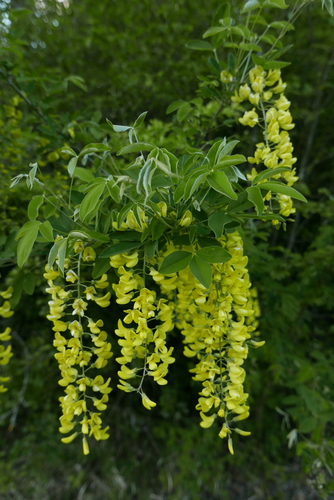
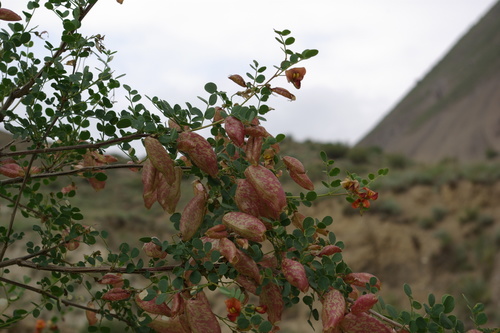
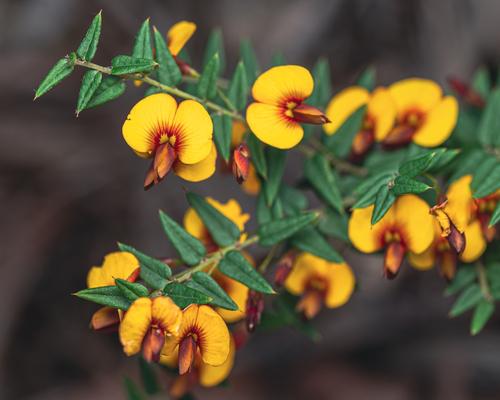
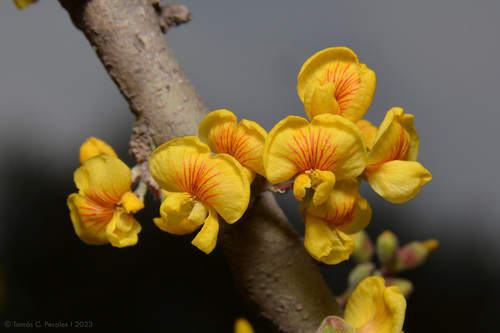
Morphology: The common name Chilean palo verde refers to the mottled green color of this tree's trunks, but the species does not closely resemble trees in the genus Cercidium. Also known as chañar, this tree typically grows quite upright with a spreading canopy, and has trunks that are both straight and mildly curving. As the trees mature, their trunks and branches develop a sculptural appearance marked by long, irregular longitudinal ridges and valleys. Along with this undulating trunk structure, large flakes of bark peel off, or decorticate, which is the origin of the species name decorticans. The peeling tan to brown bark is eventually shed, revealing the dark green, "immature" trunk underneath. The contrasting colors and textures created by this puzzle-piece pattern make the tree visually striking. Its flowers are highly visible, small, papery, and yellow. The tree blooms in spring, producing flowers either singly or in clusters. Geoffroea decorticans is unique among legumes because it produces fleshy, oval pods that each hold a single seed. The fruit starts out green, and turns deep orange as it matures. Distribution and habitat: This tree grows in dry to arid spiniferous forests across a fairly broad area of southern South America. Its range mainly covers regions I to IV of Chile, central and northern Argentina, and all of highland Bolivia; it is also found in Paraguay, Peru, and Uruguay. Other tree species that typically grow alongside it in these forests are algarrobos, quebrachos, and the related, very abundant cavens. In some areas, this species is associated with woody plant encroachment. In Chile, G. decorticans grows in USDA climate zones 8b to 10, and can tolerate short frosts down to –13 °C. This same low temperature of –13 °C is the record low for Santiago del Estero, Argentina, where G. decorticans occurs naturally. It is adapted to desert conditions and can withstand temperatures over 40 °C.