About Geocolaptes olivaceus (J.F.Gmelin, 1788)
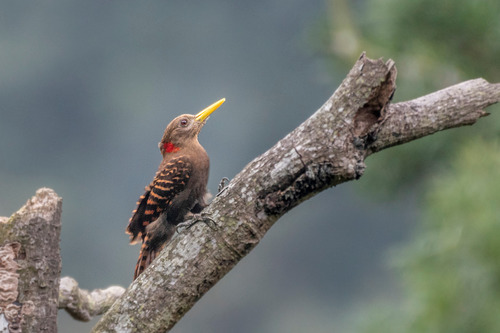
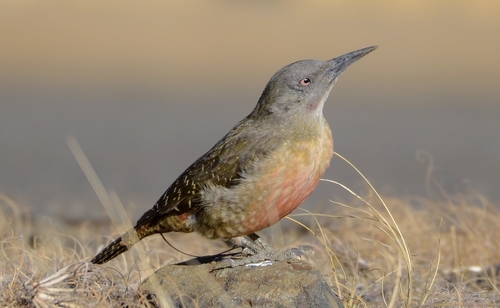
Geocolaptes olivaceus, commonly known as the ground woodpecker, is likely the largest woodpecker species found in Africa. Adults measure 22 to 30 cm (8.7 to 11.8 in) in length, with an average weight of around 120 g (4.2 oz). This species has greyish-brown upper parts marked with pale spotting, and a red rump that is most visible when the bird is in flight. The upper surfaces of the wings and tail are brown, barred with white. Underparts are buff in colour, with a pink or red flush. The underside of the tail is pale brown, barred with a paler shade. The ground woodpecker has a long, slender black beak, pink or yellow irises, and grey legs. Males and females are broadly similar in appearance, but females have slightly less red and pink colouring than males. Juveniles resemble females in appearance. Ground woodpeckers typically live in pairs or small groups. They are easiest to locate by their loud, raucous two-note call described as "chik-ree, chik-ree", which is given while the bird swings its head. When approached by intruders, they often peer around or over rocks at the disturbance. Their diet consists mainly of ants, along with ant eggs, larvae, and pupae. They extract this prey from dead wood or gaps between rocks using their long, sticky tongue. They also feed on the ground, where they flick away dead leaves in a movement similar to that of North American flickers. Unusual among woodpeckers, a member of the group will perform sentry duty from a high point to watch for aerial predators, and the on-duty bird is relieved by another group member approximately every 10 minutes. Ground woodpeckers breed in spring and early summer, from August to November. They nest in a tunnel that the birds excavate into the vertical bank of a stream or other watercourse. Females usually lay three glossy white eggs, which are placed in a chamber at the end of the excavated tunnel.