About Geococcyx velox (Wagner, 1836)
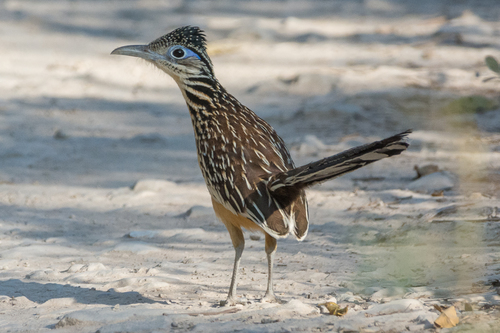
The lesser roadrunner, with the scientific name Geococcyx velox (Wagner, 1836), is a slender bird. Adults reach a total length of 46 to 51 cm (18 in), with an average total length of 46 cm (18 in); the tail alone makes up about 24 cm (9.4 in) of this length. Males weigh between 174 and 207 grams (6.1 to 7.3 oz), while females weigh between 162 and 192 grams (5.7 to 6.8 oz).
The crown, crest, and neck are black with a bronze sheen and small light brown spots. The back of the neck is black-brown; individual feathers are edged in pale brown, which creates a pattern of brown-and-white dashes. The upper body plumage is dark brown with light speckles, lightening to maroon toward the rump, and the breast is white. The tail feathers (rectrices) are black with a dark purple luster.
Juvenile lesser roadrunners resemble adults, but have ocher-colored lines and duller skin surrounding the eye. The iris ranges from yellow to brown, with a yellow to silvery-white ring around the pupil. The bare eye ring is pale lavender to bright blue. A narrow band extending from behind the eye turns bright red as it reaches the neck, and this red band is mostly covered by feathers. The upper beak is gray, and the lower beak is bluish-gray.
The lesser roadrunner resembles the greater roadrunner (Geococcyx californianus) in both appearance and habits, but is smaller overall. It also has less streaking on the throat and chest, brownish coloration on the rump and outer wings, yellowish undersides, and a significantly shorter bill than the greater roadrunner.
This species lives in arid lowlands of Mesoamerica, occurring at altitudes up to 3,000 metres (9,800 ft). It inhabits open ground areas with scrub and thorny bushes. It can also be found in semi-open areas above the treeline at higher elevations on stratovolcanoes including Conchagua, San Miguel, Santa Ana, and San Salvador. It also adapts well to cultivated land such as henequen and corn fields.
Its breeding range extends through southwestern Mexico, north along the western side of the Sierra Madre Occidental range, and covers northern Central America, with an additional separated disjunct range in the northern Yucatán Peninsula. Its range overlaps with that of the greater roadrunner in a small area spanning the Mexican states of Sonora, Sinaloa, Jalisco, and Michoacán.