About Geococcyx californianus (Lesson, 1829)
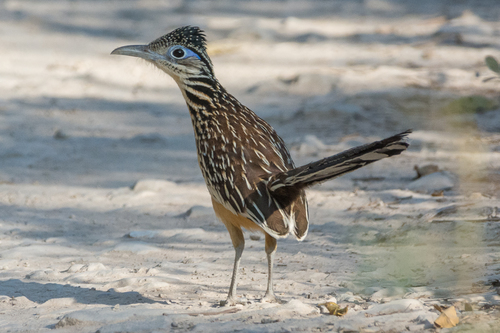
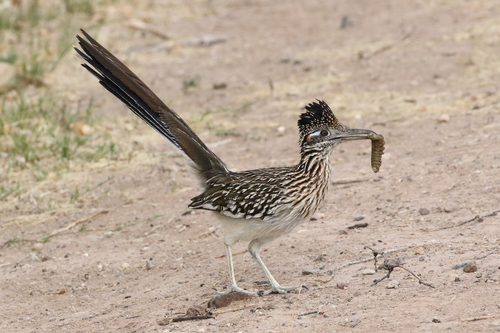
Geococcyx californianus, commonly known as the greater roadrunner, is the largest cuckoo species native to the Americas. Adults measure 52–62 cm (20–24 in) in total length, have a wingspan of 43–61 cm (17–24 in), and weigh 221–538 g (7.8–19.0 oz). They stand approximately 25–30 cm (9+3⁄4–11+3⁄4 in) tall, with females being slightly smaller on average: females are typically 2 cm (3⁄4 in) shorter and 30 g (1.1 oz) lighter than males, and males and females have identical plumage. The greater roadrunner's upper body is mostly brown with black streaks, and sometimes has pink spots. Its neck and upper breast are white or pale brown with dark brown streaks, and its belly is solid white. A crest of upright brown feathers sits on its head, and a bare patch of orange and blue skin is located behind each eye. In adult males, the blue portion of this patch (except for the blue area directly adjacent to the eye) is replaced by white, and the rearmost orange portion of the patch is often hidden by the bird's feathers. The species has a long, stout, grayish brown to gray beak with a hooked tip. Each foot is zygodactyl, with four toes total: two face forward, and two face backward. The toes are brown, with pale gold spots. Although the greater roadrunner is capable of limited flight, it spends most of its time on the ground. It can sustain running speeds up to 20 mph (32 km/h), and individual roadrunners have been recorded running as fast as 26 mph (42 km/h). This is the fastest running speed ever recorded for a flying bird, though it is far slower than the 40 mph (60 km/h) running speed of the much larger, completely flightless ostrich. The greater roadrunner is non-migratory, and is found in the Aridoamerica ecoregion, which covers the Southwestern United States and northern Mexico. It is regularly seen in the U.S. states of California, Texas, New Mexico, Arizona, Nevada, Oklahoma, Utah, and a small portion of Colorado. It is seen less frequently in Kansas, Louisiana, Arkansas, and Missouri. In Mexico, it occurs in the states of Baja California, Baja California Sur, Sonora, Sinaloa, Chihuahua, Durango, Jalisco, Coahuila, Zacatecas, Aguascalientes, Guanajuato, Michoacán, Querétaro, México, Puebla, Nuevo León, Tamaulipas, and San Luis Potosí. This species occupies elevations from 200 ft (61 m) below sea level to 7,500 ft (2,300 m), and is rarely found above 9,800 ft (3,000 m). It lives in arid and semiarid scrubland with scattered vegetation, which typically has less than 50% vegetation cover and a maximum height of less than 3.00 m (9 ft 10 in).