About Geochelone elegans (Schoepff, 1795)
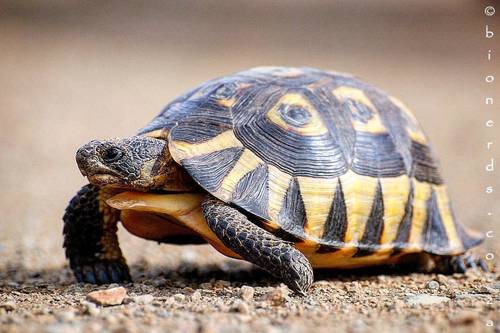
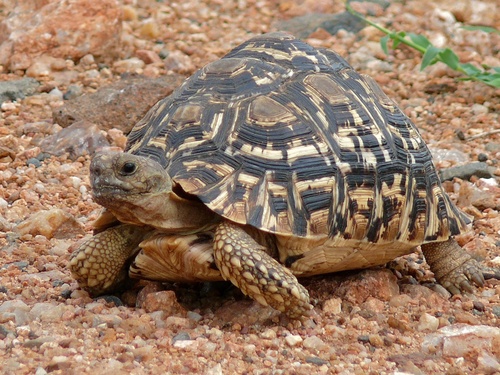
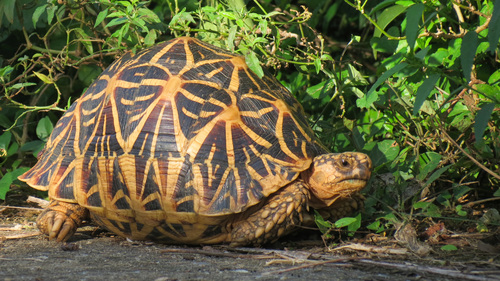
Geochelone elegans, commonly called the Indian star tortoise, has a very convex carapace, with dorsal shields often forming humps. Its lateral margins are nearly vertical, and the posterior margin is somewhat expanded and strongly serrated. This species lacks a nuchal scute; the undivided supracaudal scute is curved inward in males, and the shields bear strong concentric striations. The first vertebral scute is longer than it is broad, while all other vertebral scutes are broader than they are long, with the third at least as broad as the corresponding costal scute. Its plastron is large, truncated or openly notched at the front, and deeply notched and bifid at the back. The suture between the humeral scutes is much longer than the suture between the femoral scutes, the suture between the pectoral scutes is very short, and the axillary and inguinal sutures are rather small. The head is moderate in size, with a swollen, convex forehead covered in small, irregular shields. The beak is weakly hooked, and can be bi- or tricuspid; the jaw edges are denticulated, and the alveolar ridge of the upper jaw is strong. The outer-anterior face of the fore limbs holds numerous large, unequal-sized, imbricate, bony, pointed tubercles; the heel has large, more or less spur-like tubercles, and a group of large conical or subconical tubercles sits on the back of the thigh. The carapace is black with yellow areolae, from which numerous narrow yellow streaks radiate; the plastron also has black and yellow radiating streaks. Indian star tortoises grow up to 10 inches long. Their high-contrast patterning is disruptive, breaking up the tortoise's outline when it rests in shaded grass or vegetation. They are mostly herbivorous, feeding on grasses, fallen fruit, flowers, and leaves of succulent plants, and will occasionally eat carrion in the wild; however, they should never be fed meat when kept in captivity. Sexual dimorphism is quite clear in adult Indian star tortoises: females are considerably larger than males, and females have much flatter plastrons, while males have concave plastrons. The species' shape is hypothesized to be specially adapted to help it return to a stable stance after being flipped over. Mathematicians Gábor Domokos of the Budapest University of Technology and Economics and Péter Várkonyi of Princeton University designed a homogeneous object called a gömböc, which has exactly one unstable balance point and exactly one stable balance point. Just as a bottom-weighted sphere with nonhomogeneous weight distribution always returns to the same upright position, it is possible to construct a shape that behaves this way. The pair noted the similarity between this shape and the Indian star tortoise, then tested 30 flipped tortoises, and found that many of the tortoises could self-right. Indian star tortoises are native to parts of western and southeastern India, the island of Sri Lanka, and southeastern Pakistan. No subspecies are recognized, but there are color and morphology variations across populations from different regions. Tortoises from southeastern India tend to be slightly smaller and have a lighter, more contrasting shell pattern than those from northern India. Sri Lankan tortoises generally have wider yellow markings and are larger than Indian populations. Little was known about phylogeographic differentiation in this species until a 2006 study by Gaur, which revealed that tortoises from distribution patches between India and Sri Lanka are indeed genetically distinct. These tortoises widely inhabit many different habitat types across their native range, and display high tolerance for areas with seasonal dry and wet conditions. They have been recorded in rainy deciduous forests, dry grasslands, and even semi-desert lands. Females typically reach sexual maturity at 8–12 years old, while males reach sexual maturity at 6–8 years old. Males compete for mates and assert dominance by ramming other males and attempting to flip them onto their backs. Around 60–90 days after mating, females search for a site to dig a nest and lay their eggs. Females can lay between one and nine clutches per year, with each clutch holding one to ten eggs. After laying, females cover the eggs with sand, and the eggs incubate for 50–180 days. Star tortoise eggs have a hard but brittle shell, and usually weigh 12 to 21 grams each. When first laid, eggs are pinkish and translucent, turning white after 2–3 weeks. Offspring sex is temperature-dependent: incubation temperatures between 28–30 degrees Celsius produce mostly males, while temperatures between 31–32 degrees Celsius produce mostly females. Hatchlings do not have the characteristic star pattern; instead, their carapace is black or brown with yellow rectangular blotches.