About Geocaulon lividum (Richardson) Fernald
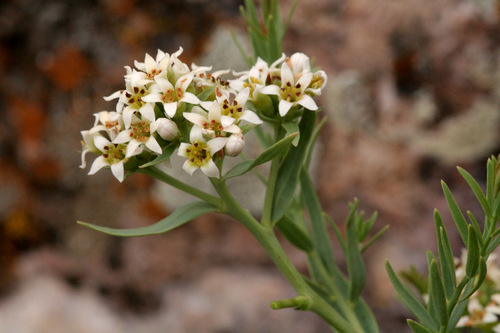
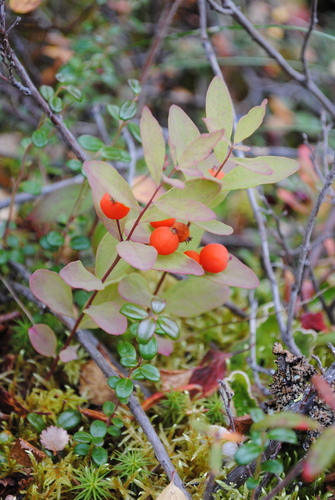
Geocaulon is a monotypic genus of flowering plants in the Santalaceae family, containing only one species: Geocaulon lividum. This species has the common names northern comandra and false toadflax. It is native to northern North America, where it is common and widespread, ranging from Alaska to Newfoundland and extending into the northernmost contiguous United States. This is a perennial herb that grows from rhizomes embedded in humus. It produces stems up to 30 centimetres (12 inches) tall, and inflorescences that hold two or three greenish or purplish flowers; typically one flower is perfect (has both male and female reproductive parts), while the others are male. Its fruit is an orange drupe that contains a single seed. This plant acts as a hemiparasite on other plant species. It grows haustoria that tap into the roots of host plants including spruce, pine, birch, willow, alder, and twinflower. It grows in many types of moist boreal habitat, including various coniferous and deciduous forests, bogs, and other wetlands. It occurs in spruce forests of the Alaskan taiga, and acts as an indicator of continental boreal and cool temperate climate in British Columbia. It is found growing alongside a wide range of other plant species, including American green alder (Alnus viridis ssp. crispa), bog Labrador tea (Ledum groenlandicum), bearberry (Arctostaphylos uva-ursi), crowberry (Empetrum nigrum), twinflower (Linnaea borealis), prickly rose (Rosa acicularis), mountain cranberry (Vaccinium vitis-idaea), bog blueberry (Vaccinium uliginosum), highbush cranberry (Viburnum edule), bunchberry (Cornus canadensis), one-sided wintergreen (Orthilia secunda), bluejoint reedgrass (Calamagrostis canadensis), horsetails (Equisetum spp.), feathermosses (Hylocomium splendens and Pleurozium schreberi), and lichens (Cladonia spp. and Peltigera aphthosa).