About Geocarpon minimum Mack.
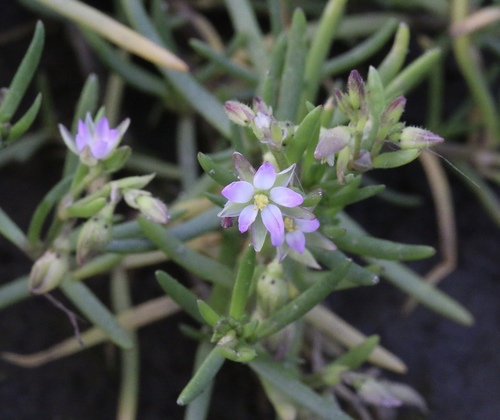
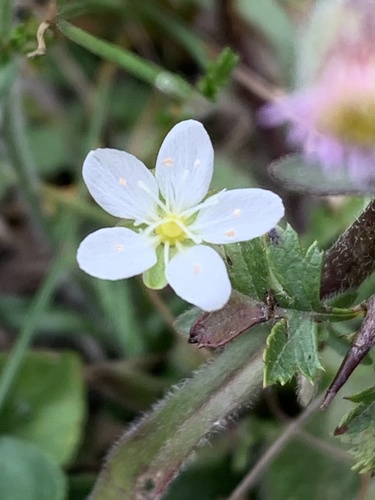
Geocarpon minimum Mack. is a flowering plant species in the carnation family (Caryophyllaceae), with common names tinytim and earth-fruit. This rare plant is known from around 34 populations across the U.S. states of Arkansas, Louisiana, Missouri, Texas, and Oklahoma. Most of its populations are located in Missouri, with only a few scattered in the nearby surrounding states; a new population was discovered in Anderson County, Texas, in 2004. This species is thought to have been widespread across the North American continent long ago, but climate change left it as a relict species restricted to a narrow strip of hospitable habitat. It grows on sandstone glades and outcrops, as well as bare, sparsely vegetated areas where soil contains relatively large amounts of magnesium and sodium salts. It also occurs on formations called "slicks", which have a coating of lichens and Nostoc cyanobacteria; these slicks become very wet after winter rain, then dry into a hard crust, and lichens of the genus Xanthoparmelia grow on these surfaces. Very few other flowering plants can survive in this harsh habitat. It is an ephemeral annual species: it sprouts and completes its entire life cycle within four weeks, generally around February and March, though this cycle may be delayed as late as June in some areas. The yearly abundance of this tiny plant in any given location depends on recent rainfall; populations are small or non-existent in dry years, and can contain thousands of individuals in a wet season. Geocarpon minimum is a petite succulent that grows no more than 4 centimeters (1.6 inches) tall, with a hair-thin stem. Young new growth is grayish, brownish, or green, and the plant turns magenta, red, bright pink, or purplish as it matures; this red color comes from anthocyanins. It has tiny leaves 3 to 4 millimeters long, and produces a red or purplish inflorescence holding a single flower that is no more than 4 millimeters long. Geocarpon minimum requires a very specific habitat type. The slicks and saline prairies it inhabits have become uncommon due to soil changes. As the substrate becomes more suitable for other types of flowering plants, G. minimum is easily outcompeted. It is not currently clear what causes these soil changes. The species likely requires some form of disturbance, such as fire, to keep soil bare, eroded, and salty. However, too much disturbance can destroy this habitat type. For example, cattle grazing tends to alter soil to allow other plants to take hold, converting bare patches to prairie, but there is also evidence that intensive grazing can suppress larger plants and allow G. minimum to grow. Off-road vehicles are known to destroy habitat, but the disturbance they create may also help keep soil barren enough for the species. More research will likely help clarify this plant's ecological relationships. There are multiple threats to this species' survival, and it was listed as a threatened species of the United States in 1987. Although the species still has a limited range and minor threats continue to exist, it has a "high recovery potential" and is almost ready to be removed from the endangered species list. Since its listing, more populations have been discovered, and several new populations have been planted in appropriate habitat. Even so, existing populations require additional monitoring to ensure long-term survival, and research is needed to document the genetic variability of the species across its range. There has been some scientific disagreement over which plant family this genus should be placed in. Mackenzie placed it in Aizoaceae in his original species description, but most modern taxonomists classify it as a member of Caryophyllaceae.