About Geocarpon groenlandicum (Retz.) E.E.Schill.
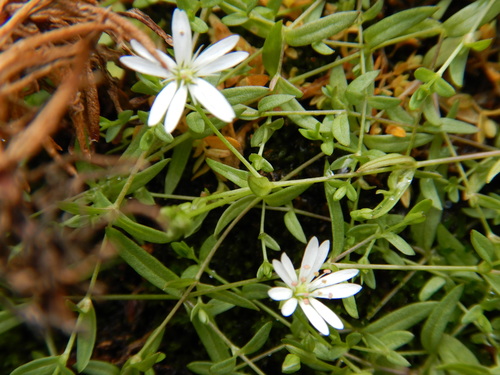
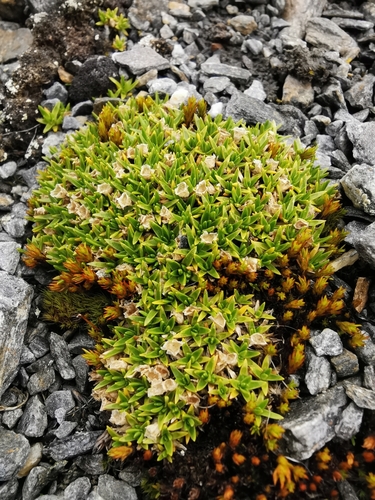
Geocarpon groenlandicum (Retz.) E.E.Schill. is commonly known by several common names: Greenland stitchwort, mountain stitchwort, Appalachian stitchwort, mountain sandwort, smooth mountain sandwort, and smooth sandwort. This rare perennial plant grows low to the ground, forming clumps that are connected at the base. Along its slender stems, three to five pairs of linear leaves grow in an opposite arrangement. The main stem branches into one to thirty cymes, each of which produces a separate flower. The white flowers grow five to ten centimeters above the plant's thick foliage. Each white flower petal measures six to ten millimeters long, and the petals are surrounded by five green sepals. This species occurs across many isolated, elevated areas, including large mountain plateaus. In Canada, its distribution includes Nunavut, Ontario, Quebec, Newfoundland and Labrador, and Nova Scotia. In the United States, it can be found in Maine, New Hampshire, Vermont, New York, West Virginia, Maryland, Virginia, Tennessee, North Carolina, and South Carolina. It is also native to Greenland. Within Nova Scotia, it only occurs in a small number of locations in Inverness County and along the south shore. Its peak flowering period lasts two weeks in mid-July, though flowering can occur any time between June and August. During this flowering period, insects transport pollen between flowers. The most effective pollen vector is the bumblebee Bombus terricola, which is able to collect pollen on its tiny hairs and crawls over entire flowers when temperatures are too low for flight. Geocarpon groenlandicum inhabits high elevation areas with exposed bedrock, growing on rocky ledges and in fine gravel on slopes. The soil in its habitat has a pH between 3.1 and 4, is low in nitrogen and phosphorus, and high in organic matter content. Its native range is very cloudy, with frequent fog and high precipitation. One study site on Mount Washington recorded an average annual precipitation of 1837.5 millimeters, an average wind speed of 50 km/h, and a mean annual temperature of -3.0 °C. This species was studied for use as a roof plant for insulation and urban greenery applications, but it could not tolerate drought long enough to be used successfully. In Nova Scotia, Greenland stitchwort is sensitive to both human interference and natural disturbance events, and it holds a conservation status of yellow in the province.