About Gentianella germanica (Willd.) E.F.Warb.
Gentianella germanica, commonly called German gentian, is an annual or biennial plant species. Mature stems reach 5 to 40 centimeters (2 to 16 inches) in height, and may be branched or unbranched, though plants most often have very few branches. Annual individuals are smaller in all measurements than biennial individuals. Biennial plants grow a rosette of basal leaves in their first year; in the second year, stems develop, and the original basal leaves usually wither before flowering begins.
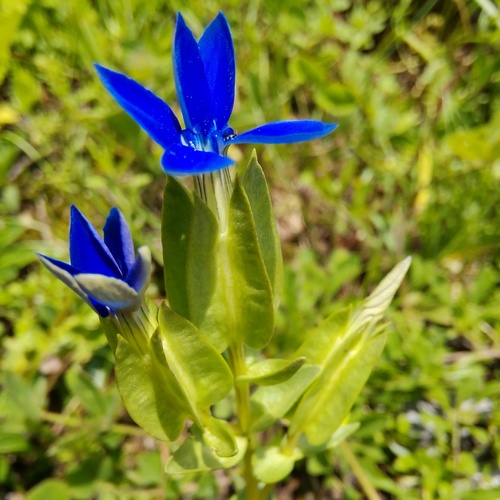
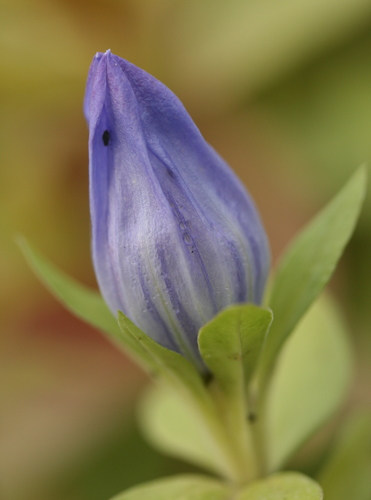
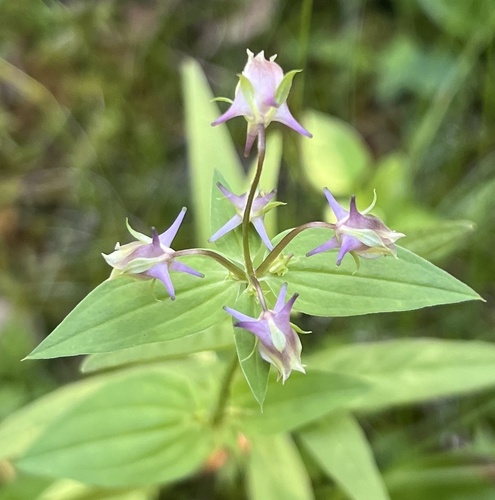
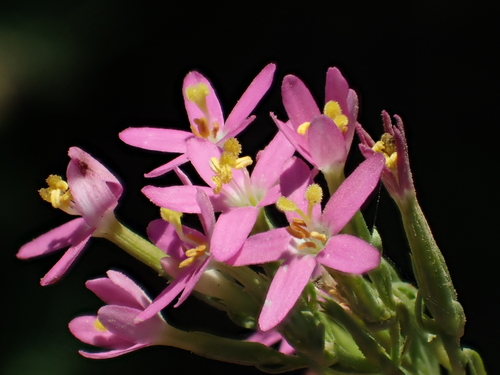
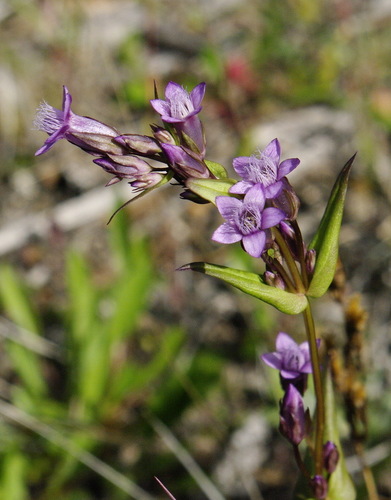
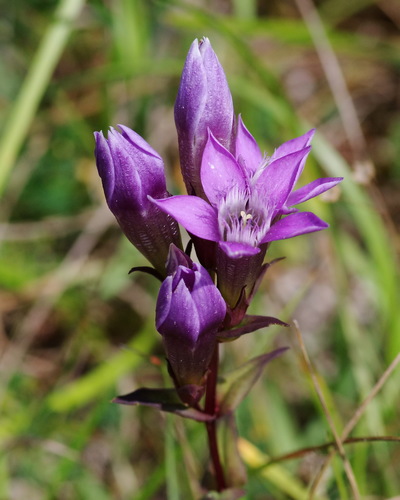
Stem leaves are deep green, arranged in opposite pairs along the stem. They are wider at the base and taper to a sharp point, and may be shaped like an egg (ovate), a slightly tapered egg similar to a spear head (ovate-lanceolate), or an egg-shaped triangle (ovate-triangular). Flowers emerge from leaf axils (the angle between a leaf and the stem), with the flower at the end of each branch opening first. Flowers are most often reddish-violet, though white-flowered individuals occur occasionally, and are funnel-shaped. They grow up to 3.5 centimeters (1.4 inches) long, with sepals that are partially fused at the base and split into five somewhat uneven pointed lobes higher up. The floral tube splits into five pointed petal lobes, though four-lobed flowers sometimes occur. These lobes can grow up to 15 millimeters long and have slightly rough edges. A ring of long hairs lines the inside of the floral tube, a trait that distinguishes species in the genus Gentianella from species in the genus Gentiana. Each flower holds five stamens and two stigmas within the floral throat. A single plant produces between 4 and 47 flowers total over its blooming period, which can start as early as May and end as late as October.
Gentianella germanica is native to Western and Central Europe, ranging from south-central England to the Czech Republic. It is most common in northern France, and locally common in England from the Chiltern Hills to northern Hampshire. In the low countries of the Netherlands, Belgium, and Luxembourg, it grows mostly inland, away from coastlines. In Germany, it is widespread primarily in southern states including Baden-Württemberg, Bavaria, Hesse, Rhineland-Palatinate, and Saarland, but can also be found further north and east in Lower Saxony, North Rhine-Westphalia, Saxony, Saxony-Anhalt, and Thuringia. It is also native to Switzerland, and to mountainous areas of the Czech Republic and Poland; botanist Michael Hassler notes that some southeastern records may instead refer to the species Gentianella rhaetica. Per the German Federal Agency for Nature Conservation, it is also native to mountainous areas of northern Italy, all of Austria except its eastern regions, and a small area of northern Slovenia.
German gentian most often grows in grasslands on nutrient-poor, calcareous, typically fairly moist soils, but can also be found in open scrublands. It readily colonizes bare chalk soil in chalk pits, areas disturbed by rabbits, and areas disturbed by off-road vehicles, but is not a strong competitor against other plant species. In the mountains of Upper Silesia, Poland, this species also grows on calamine mining waste contaminated with heavy metals including zinc, lead, and cadmium. It grows across a wide elevation range, from lowland to alpine habitats.
The flowers of German gentian are pollinated by solitary bees, bumblebees, hoverflies, and owlet moths. Populations growing on heavy metal-contaminated soils produce more flowers, seeds, and leaves on average than populations growing in the species' typical habitat.