About Gentianella campestris (L.) Börner
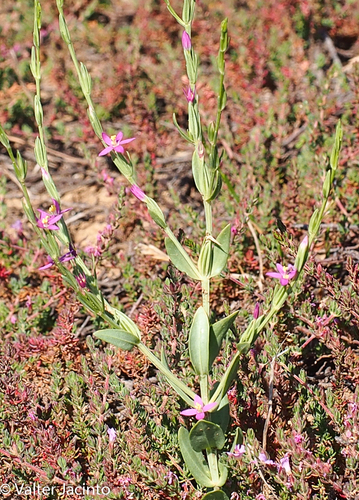
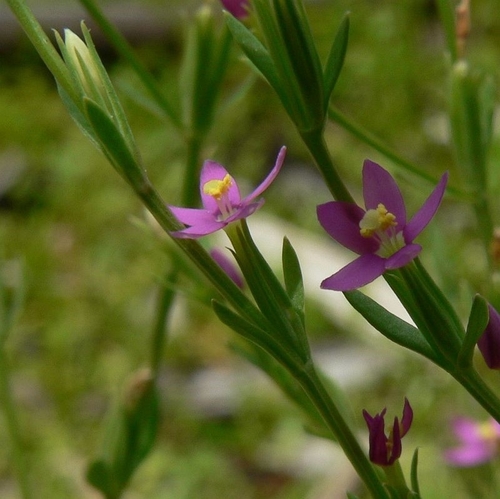
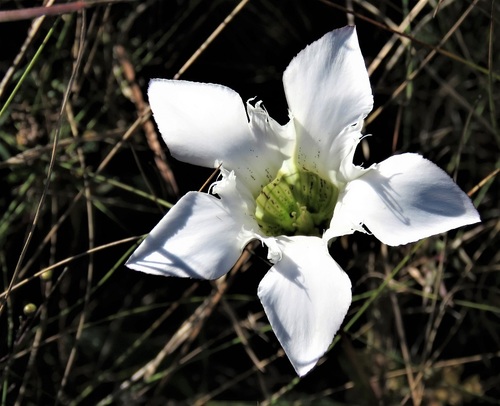
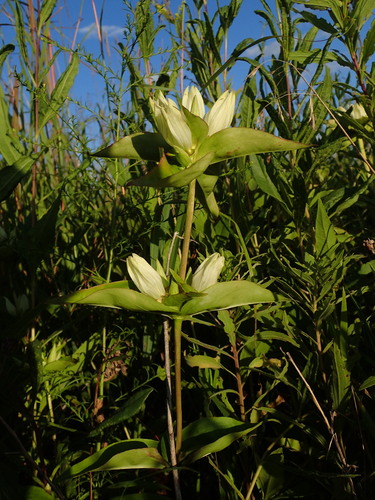
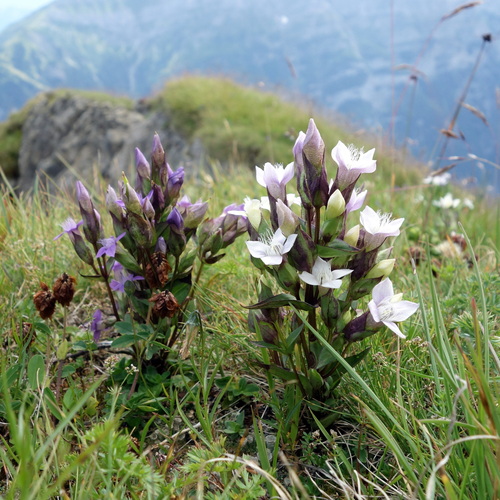
Gentianella campestris, commonly known as field gentian, is a small biennial plant that reaches an average height of 3–30 centimetres (1.2–11.8 in). It grows with erect stems that are either simple or branched at the base. Its leaves are opposite, ovate-lanceolate, and unstalked. The flowers measure 15–30 millimetres (0.59–1.18 in) across, and are most commonly bluish-purple, though they may also be white, pink, or lilac. Both the petals and sepals are fused, making this species both gamopetalous and gamosepalous. There are four petals, which are ciliate at the base, and four sepals of differing sizes: two are wide and two are narrow. Its flowering period runs from June to October, and it produces a capsule as its fruit. Field gentian is widespread across northern, central, and southern Europe, with its distribution covering the European Alps and the Jura. It grows best on moderately moist to fairly dry, neutral or acid soils. It can be found in alpine meadows, lawns, pastures, forest clearings, and roadsides, typically at altitudes between 1,000–2,300 metres (3,300–7,500 ft) above sea level. On the Isle of Man, the species grows successfully at sea level in the Ayres National Nature Reserve.