About Gentiana andrewsii Griseb.
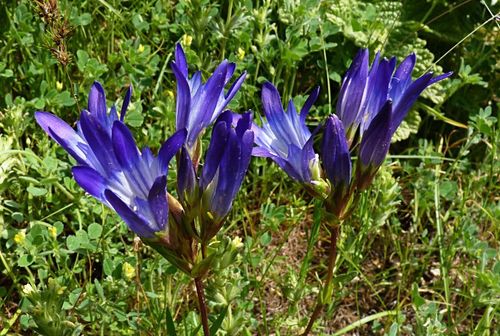
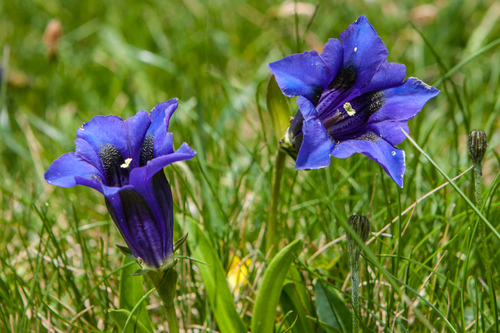
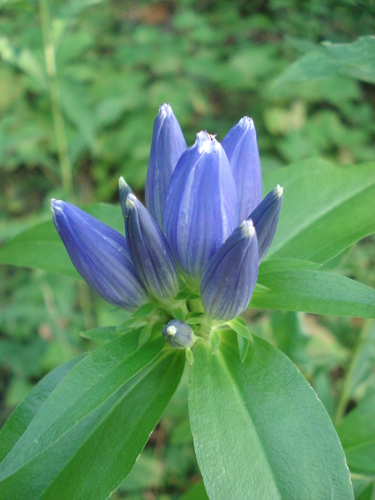
Gentiana andrewsii is a perennial herb that flowers from late summer, between August and October. Its flowers measure 2 to 4 cm (3⁄4 to 1+1⁄2 inches) long. They are typically a deep rich blue, shaped like a bottle, with fused sympetalous petals and closed mouths. Flowers grow in clusters at the top of the plant, or in the axils of the plant’s topmost leaves. Stems reach 30 to 60 cm (12 to 24 inches) long and have a lax growth habit, forming sprawling plants with upturned ends that hold clusters of bee-pollinated flowers. The plant’s hairless foliage has a glossy sheen. Ecologically, closed bottle gentian grows in wet to dry-mesic prairies and prairie fens, growing mostly in loamy soils, though it can also be found in sandy areas like Great Lakes shorelines. The species’ closed flowers make it difficult for most insect species to enter and feed on pollen or nectar. Only strong insects can push through the top opening of the flower; these include digger bee species Anthophora terminalis, and bumblebee species Bombus fervidus, Bombus griseocollis, and Bombus impatiens. Eastern carpenter bee (Xylocopa virginica) practices nectar robbing: it chews a narrow slit at the base of the flower to steal nectar without pollinating the plant. The holes that eastern carpenter bees leave in petals also allow smaller insects to access the flower’s nectar and pollen; these smaller insects include honeybee (Apis mellifera), green sweat bee species Augochlorella aurata and Augochlorella persimilis, and eastern masked bee (Hylaeus affinis). This gentian is classified as a threatened species in the U.S. states of New York and Maryland, and is listed as Endangered and a Species of Greatest Conservation Need in Massachusetts.