About Genoplesium rufum (R.Br.) D.L.Jones & M.A.Clem.
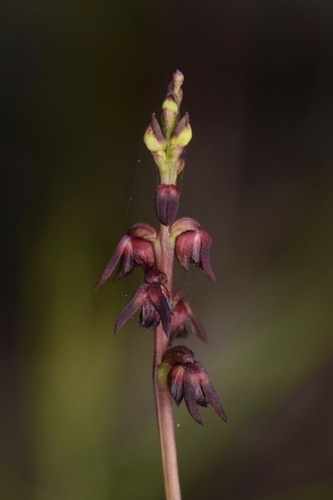
Genoplesium rufum is a terrestrial, perennial, deciduous, sympodial herb that produces a single wiry leaf fused to its flowering stem. The total leaf length ranges from 100 to 160 mm (4 to 6 inches), and its unfused free portion is 10 to 20 mm (0.4 to 0.8 inches) long. Between five and twenty five pinkish to reddish flowers are crowded along a flowering stem that stands 10 to 40 mm (0.4 to 2 inches) tall. The flowers droop forwards, and measure 3.5 to 4.5 mm (0.1 to 0.2 inches) long by 3 to 5 mm (0.1 to 0.2 inches) wide. Like other species in the genus Genoplesium, the flowers of this species are inverted, meaning the labellum sits above the column rather than below it. The dorsal sepal is egg-shaped, 2 to 3 mm (0.08 to 0.1 inches) long, 1 to 2 mm (0.04 to 0.08 inches) wide, and ends in a sharp point. The lateral sepals are linear to lance-shaped, approximately 3 mm (0.1 inches) long and 1 mm (0.04 inches) wide, with expanded bases that diverge from each other. The petals are egg-shaped, approximately 2 mm (0.08 inches) long and 1 mm (0.04 inches) wide, with a pointed tip. The labellum is egg-shaped, whitish or pinkish, 2 to 3 mm (0.08 to 0.1 inches) long, and 1.5 to 2 mm (0.06 to 0.08 inches) wide; it sometimes has small, irregular teeth along its edges. A blackish callus sits in the centre of the labellum, and extends almost to the labellum's tip. Flowering occurs between January and May. This species, commonly called the rufous midge-orchid, is locally common in forest between Ku-ring-gai and Bargo. It was previously thought to also occur in Queensland, Victoria, South Australia and Tasmania, but specimens from those states are now classified as Corunastylis clivicola, which is also known as Genoplesium clivicola.