About Genoplesium morrisii (Nicholls) D.L.Jones & M.A.Clem.
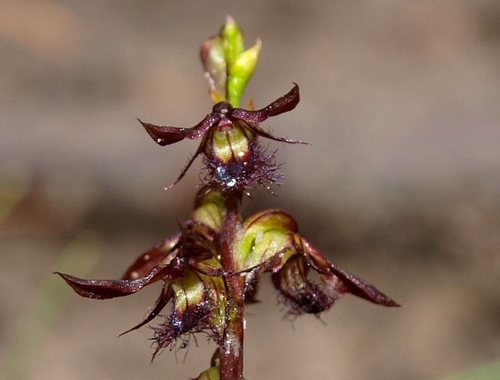
Genoplesium morrisii is a terrestrial, perennial, deciduous herb that has an underground tuber and a single thin leaf. The leaf measures 200 to 250 mm (8 to 10 in) long, is fused to the flowering stem, and has a free section that is 10 to 22 mm (0.4 to 0.9 in) long. Between three and fifteen dark purplish-black or green and purple flowers are crowded along a flowering stem that is 35 to 50 mm (1 to 2 in) tall. The flowers are about 11 mm (0.4 in) long and 9 mm (0.4 in) wide, and are inverted: the labellum is positioned above the column rather than below it. The dorsal sepal is egg-shaped, 5 to 6 mm (0.20 to 0.24 in) long and about 2.5 mm (0.1 in) wide, marked with dark purplish-black stripes. The lateral sepals are linear to lance-shaped, about 7 mm (0.3 in) long and 1.5 mm (0.06 in) wide, and spread apart from each other. The petals are lance-shaped to egg-shaped, about 4 mm (0.2 in) long and 1.5 mm (0.06 in) wide, ending in a pointed tip. The labellum is lance-shaped to narrow egg-shaped, about 4 mm (0.2 in) long and 1.5 mm (0.06 in) wide, and vibrates in even the lightest breeze. The sides of the labellum are lined with many coarse, spreading cilia, and a narrow oblong callus sits in the centre of the labellum, extending about halfway to the labellum's tip. Flowering of this species takes place between January and April. Genoplesium morrisii grows in forest, woodland and heath habitats. It is widespread and common in the southern half of Victoria. It is rarely found in Tasmania, and may possibly occur in the far south-east of New South Wales.