About Genoplesium filiforme (Fitzg.) D.L.Jones & M.A.Clem.
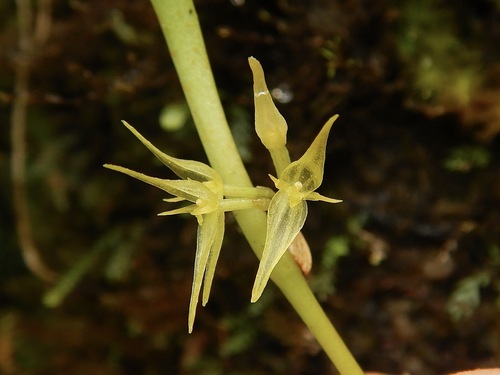
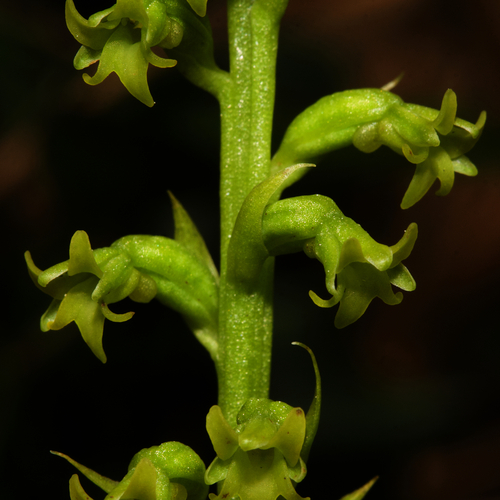
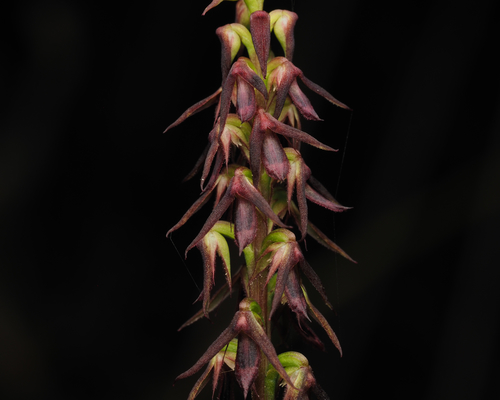
Genoplesium filiforme (Fitzg.) D.L.Jones & M.A.Clem. is a terrestrial, perennial, deciduous herb that grows from an underground tuber. It produces a single thin leaf 150–300 mm (6–10 in) long, with a free portion 10–20 mm (0.4–0.8 in) long. Between five and thirty greenish to purple flowers are arranged along a flowering stem that is 10–45 mm (0.4–2 in) tall. Individual flowers are 6.5 mm (0.3 in) long and 5 mm (0.20 in) wide. Like other species in the genus Genoplesium, the flowers are inverted, so the labellum sits above the column rather than below it. The dorsal sepal is egg-shaped, 3.5–4.5 mm (0.1–0.2 in) long, about 2 mm (0.08 in) wide, with a pointed tip and short hairs along its edges. The lateral sepals are linear to lance-shaped, 4–6 mm (0.16–0.24 in) long, about 1 mm (0.04 in) wide, and spread widely apart from each other. The petals are narrow egg-shaped, about 3 mm (0.1 in) long and 1 mm (0.04 in) wide, and also have hairs along their edges. The labellum is egg-shaped with its narrower end toward the base, 3–4 mm (0.1–0.2 in) long, about 2 mm (0.08 in) wide, with short hairs on its edges. An oblong callus sits in the centre of the labellum and extends across three-quarters of the labellum’s length. Flowering occurs between February and May. This species grows in forest, heath, and moss gardens over sandstone in near-coastal areas, and is found between Nowra in New South Wales and Helidon in Queensland.